



The History of the Halberd
August 6th, 2026
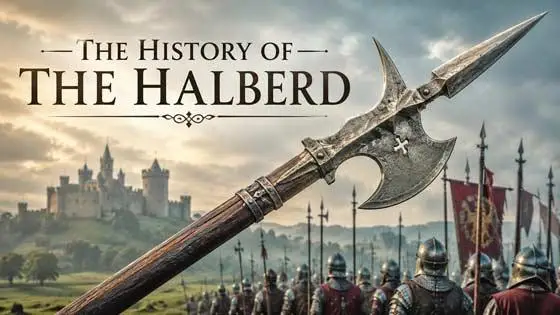
The halberd may not have the legendary reputation of the sword or the elegant mystique of the spear, but for centuries it was one of the most effective weapons on the battlefield. Combining the chopping power of an axe, the reach of a spear, and the versatility of a hook, the halberd gave ordinary foot soldiers the ability to challenge armored knights and mounted cavalry alike. It was more than just another polearm. It was a revolutionary weapon that helped reshape medieval warfare. From the battlefields of Switzerland to the ceremonial guards of the Vatican, the history of the halberd is a story of innovation, survival, and one of the most influential weapons ever carried into combat.
Why the Halberd Was Unlike Any Other Medieval Weapon
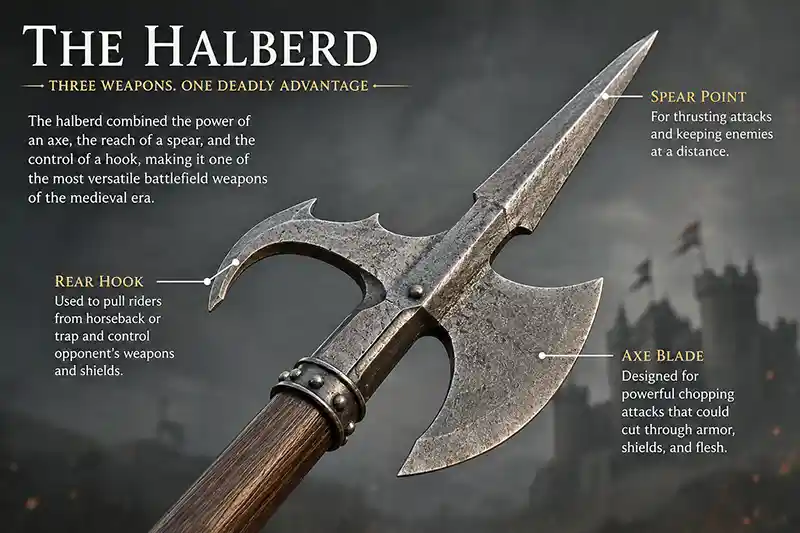
At first glance, the halberd looks like someone combined three different weapons into one. In reality, that's almost exactly what happened. Medieval weapon makers recognized that no single weapon could excel in every situation, so they designed the halberd to perform several battlefield roles at once. Mounted on a long wooden shaft, it combined an axe blade for chopping, a spear point for thrusting, and a rear hook for pulling riders from horseback or manipulating an opponent's weapon.
That versatility gave the halberd a tremendous advantage over more specialized weapons. A swordsman had to close the distance before attacking, while a spearman relied almost entirely on thrusts. The halberd could stab, chop, hook, and even strike with the butt of the shaft when fighting became crowded. Few weapons offered so many options in the hands of a skilled soldier.
This adaptability helped the halberd remain effective for centuries, even as armor and battlefield tactics evolved. Like the war hammer, it was created to solve practical military problems rather than impress with elegance. Medieval commanders valued weapons that could handle unpredictable combat, and the halberd proved itself time and time again.
Although it became one of Europe's defining polearms, the halberd was also part of a much larger tradition. Across the world, armies developed long-handled weapons that combined reach with multiple attack options. The halberd simply became one of the finest examples of that idea, earning a reputation as one of the most versatile battlefield weapons ever created.
How Swiss Infantry Turned the Halberd Into a Battlefield Legend
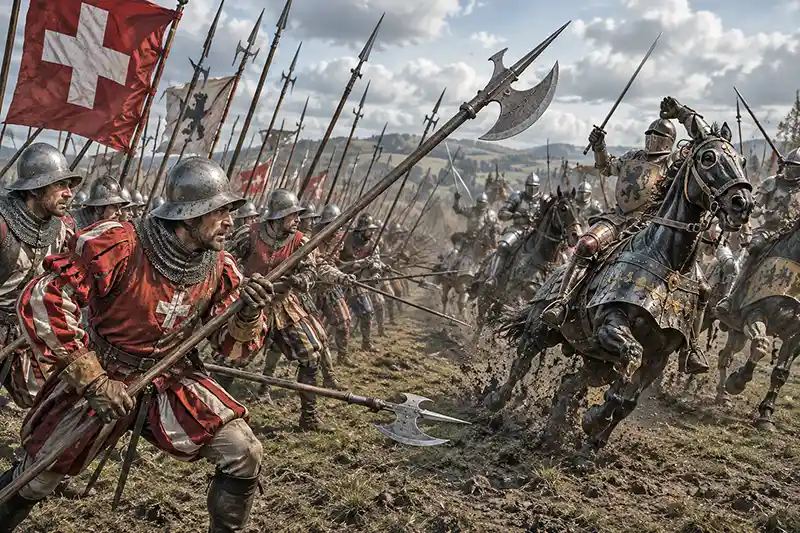
The halberd became famous largely because of the Swiss infantrymen who wielded it with devastating discipline. During the 14th and 15th centuries, Swiss forces earned a reputation for defeating larger and better-equipped armies, including heavily armored knights who had long dominated European warfare. Their success came not from expensive cavalry, but from tightly organized formations of foot soldiers armed with long polearms.
In battle, Swiss troops used pikes to stop cavalry charges and halberds to finish the fight once enemy formations broke apart. The halberd was especially valuable at close range, where its axe blade could deliver powerful chopping blows and its hook could pull armored riders from the saddle. A knight who survived the initial wall of pikes could suddenly find himself surrounded by infantrymen carrying weapons designed to attack from several angles.
The Swiss did not treat the halberd as a crude tool for brute force. Soldiers trained to use its length, balance, and multiple striking surfaces with precision. They could thrust with the spear point, strike with the blade, hook shields or limbs, and use the shaft to control distance. In disciplined hands, the weapon became far more dangerous than its unusual appearance suggested.
Their victories helped spread the halberd across Europe. Other armies began adopting similar weapons and copying Swiss tactics, recognizing that well-trained infantry could stand against elite cavalry. Just as the yari transformed Japanese battlefields, the halberd helped prove that coordinated foot soldiers could challenge the most powerful warriors of their age.
How the Halberd Brought Knights Down to Earth
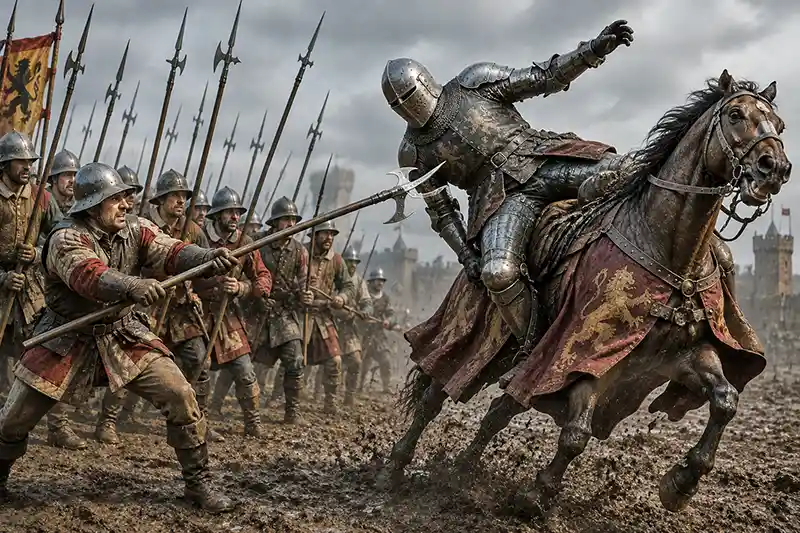
For generations, mounted knights had dominated European battlefields through speed, armor, and sheer psychological impact. A cavalry charge could shatter poorly organized infantry before the fighting even began. The halberd helped change that balance by giving foot soldiers a weapon that could threaten both the rider and the horse from a safer distance.
The spear point allowed halberdiers to brace against an approaching charge, while the rear hook gave them a way to catch armor, reins, or limbs as a rider passed. Once a knight lost balance or fell from the saddle, the axe blade could be used against exposed joints and vulnerable sections of armor. The weapon did not need to overpower a horse directly. It only needed to disrupt the rider long enough for the formation to finish the fight.
This was especially effective when halberdiers worked together rather than fighting alone. One soldier could threaten the horse with the point, another could hook the rider, and a third could strike once the cavalryman was trapped. In a disciplined formation, the halberd turned the strengths of mounted combat into liabilities. Speed made the rider harder to stop, but it also increased the consequences of being caught off balance.
That ability helped place the halberd among the most intimidating weapons in history. A knight facing a wall of halberds was not simply confronting a line of infantry. He was facing a weapon specifically shaped to strip away the advantages of cavalry and drag elite warriors into a fight on foot.
Why the Halberd Replaced Simpler Polearms
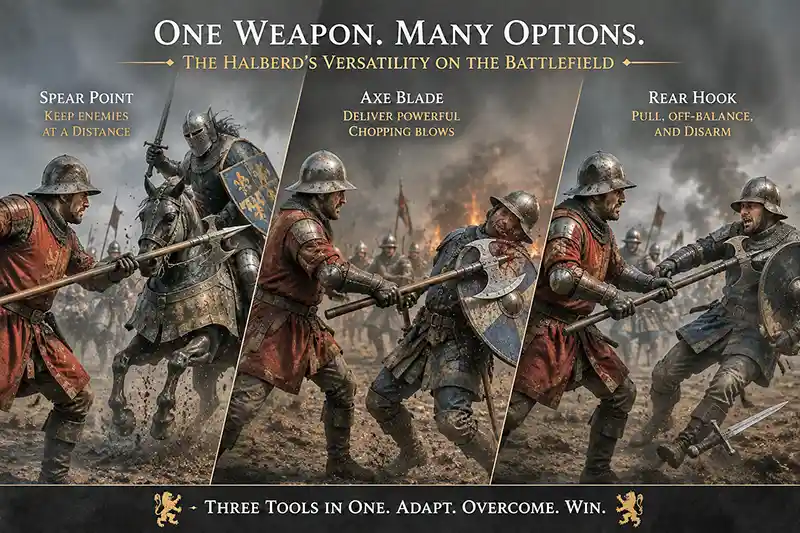
Early polearms were often designed to do one thing well. Spears excelled at keeping enemies at a distance, while axes delivered powerful chopping blows once an opponent came within reach. The halberd combined those strengths into a single weapon, giving soldiers far more flexibility without sacrificing the advantages of a long shaft.
On a chaotic battlefield, that versatility mattered. An infantryman might begin by using the spear point to hold back advancing cavalry, switch to the axe blade once the fighting closed, and then use the rear hook to pull away a shield or unbalance an armored opponent. Instead of carrying multiple weapons, a halberdier had nearly every tool he needed in his hands.
This was especially valuable as medieval battles became larger and more unpredictable. Soldiers could no longer assume they would face only cavalry or only infantry. They needed weapons that could adapt from one moment to the next, and the halberd answered that challenge better than almost any other polearm of its era.
Its success inspired countless variations across Europe, with different regions modifying the blade, hook, and shaft to suit local fighting styles. Like many of the weapons that proved more effective than swords, the halberd earned its reputation by solving practical battlefield problems instead of relying on prestige or tradition.
Why the Halberd Was the Ultimate Weapon for Foot Soldiers
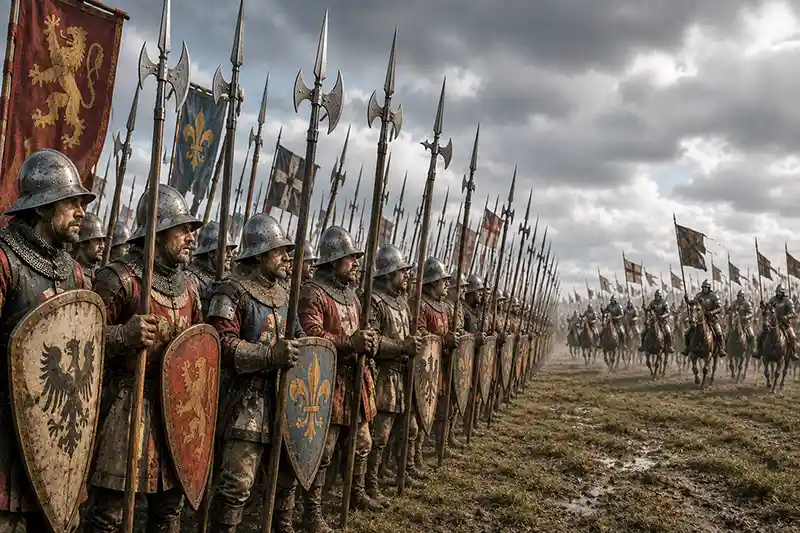
The halberd's greatest achievement was not its design alone. It was the way it transformed the role of the ordinary infantryman. For much of the Middle Ages, heavily armored knights were viewed as the dominant force on the battlefield. A well-trained foot soldier often had little chance against a mounted noble charging into combat. The halberd helped level that playing field.
Its long reach allowed infantry to engage mounted opponents before a sword could come into range, while its combination of chopping, thrusting, and hooking attacks gave soldiers multiple ways to respond as the battle evolved. Rather than depending on individual heroics, halberdiers relied on discipline and teamwork, fighting shoulder to shoulder in tightly organized formations that became increasingly difficult for cavalry to penetrate.
The weapon was also relatively economical to produce compared to the expensive swords carried by many knights. A sturdy hardwood shaft fitted with a forged steel head gave armies an exceptionally capable weapon that could be issued to large numbers of soldiers. This allowed commanders to field disciplined infantry forces without the enormous cost of equipping every man with a finely crafted sword.
As the halberd spread across Europe, it became a symbol of the growing importance of professional infantry. Along with other battlefield innovations, it helped shift military power away from individual knights and toward organized formations of trained soldiers. Few weapons illustrate that transition better, making the halberd one of the most influential polearms in medieval history.
How the Halberd Evolved Across Europe
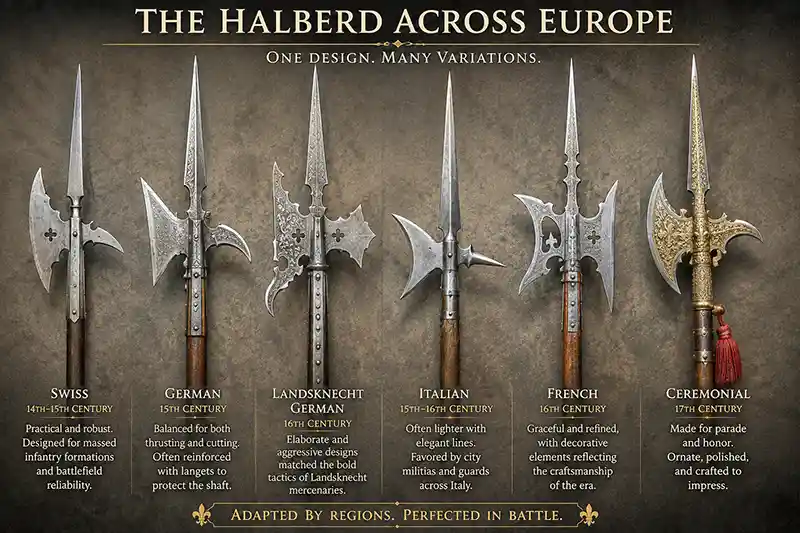
The halberd did not remain a single fixed design. As it spread across Europe, armorers and soldiers reshaped it to match local tactics, armor, and battlefield conditions. Some versions featured broad axe blades built for powerful chopping strikes, while others used narrower blades, longer spear points, or more aggressive hooks designed to catch armor and weapons.
German, Swiss, Italian, and French examples could look noticeably different, even though they all followed the same basic formula. Wealthier soldiers and ceremonial guards sometimes carried beautifully engraved halberds with ornate cutouts and polished metalwork. Battlefield models were usually simpler, heavier, and built to survive repeated impacts.
The shaft changed as well. Some halberds were fitted with metal strips called langets that ran down the wood beneath the head. These reinforcements helped prevent swords and axes from cutting through the handle during combat. Small changes like these made the weapon more durable without sacrificing its balance or reach.
Over time, the halberd became less like a modified farm tool and more like a carefully engineered military weapon. Its changing forms reveal how closely medieval weapon design followed battlefield experience. Every added spike, reinforced shaft, and reshaped blade reflected a lesson learned in real combat.
That constant evolution also explains why surviving halberds can look so different from one another. Like the strangest weapons ever carried into real battles, some designs appear almost too elaborate to be practical. Yet beneath the decoration, the same deadly combination of reach, cutting power, and control remained.
How the Halberd Became a Symbol of Power
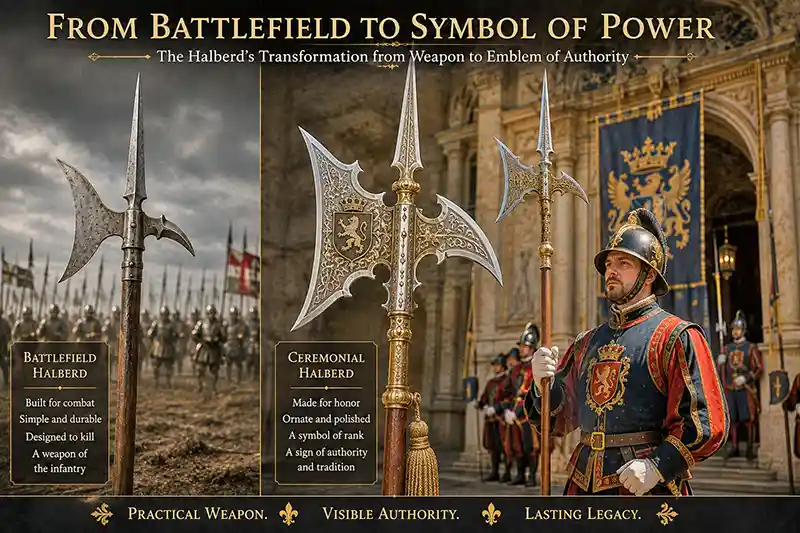
By the 16th century, firearms and longer pikes were beginning to change the battlefield. The halberd remained dangerous, but its role slowly shifted. Instead of disappearing completely, it found a new purpose in the hands of palace guards, royal bodyguards, and military officers who valued the weapon for its imposing appearance as much as its combat ability.
Ceremonial halberds became increasingly elaborate. Plain steel heads were replaced by polished blades covered with engravings, decorative cutouts, coats of arms, and gold accents. Some were designed for royal processions or court ceremonies rather than actual fighting, yet they retained the axe blade, spear point, and hook that made their battlefield ancestors instantly recognizable.
The weapon also became a visible sign of rank. Sergeants and guards could carry halberds to distinguish themselves from ordinary soldiers, allowing commanders to be identified quickly within crowded formations. A tall, decorated polearm was difficult to overlook, making it useful as both a badge of authority and a practical tool for directing troops.
This transformation helped the halberd survive long after many other medieval weapons had vanished. What began as a rugged infantry weapon evolved into a symbol of discipline, tradition, and state power. Its battlefield importance declined, but its unmistakable silhouette remained closely associated with elite guards and military ceremony for centuries.
Why the Halberd Disappeared from the Battlefield
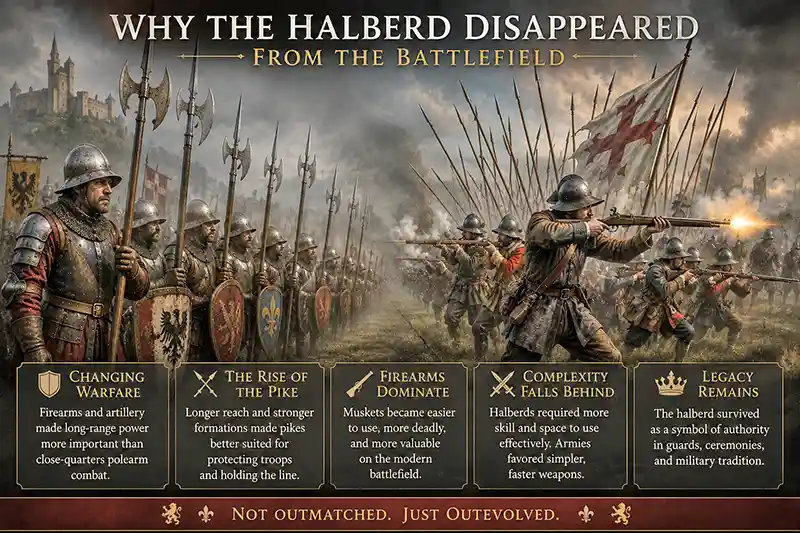
The halberd remained effective for centuries, but no weapon can survive unchanged when warfare itself transforms. By the 16th and 17th centuries, firearms were becoming more powerful, reliable, and common. Musketeers could strike armored opponents from a distance, while artillery disrupted the dense infantry formations that had once made polearms so formidable.
Long pikes also began taking over many of the halberd's battlefield duties. Their greater reach made them better suited for protecting formations of gunpowder troops from cavalry attacks. Halberds were still useful once enemies reached close quarters, but commanders increasingly preferred simpler combinations of pikes, firearms, and swords.
The weapon's complexity became another disadvantage. A halberd required room to swing, thrust, and hook effectively, while firearms demanded less physical training to become dangerous. As armies grew larger and more standardized, weapons that could be produced quickly and taught efficiently became more valuable than highly versatile polearms requiring extensive practice.
The halberd did not disappear because it had failed. Like the war hammer, it was gradually pushed aside because the battlefield problem it had been designed to solve was changing. Armored cavalry declined, gunpowder dominated military planning, and close-range polearm combat became less central to victory.
Even after its frontline role ended, the halberd remained too recognizable to vanish completely. Guards, officers, and ceremonial units continued carrying it as a symbol of military authority, preserving the silhouette of a weapon that had once helped foot soldiers challenge knights and reshape European warfare.
Why the Halberd Still Survives Today
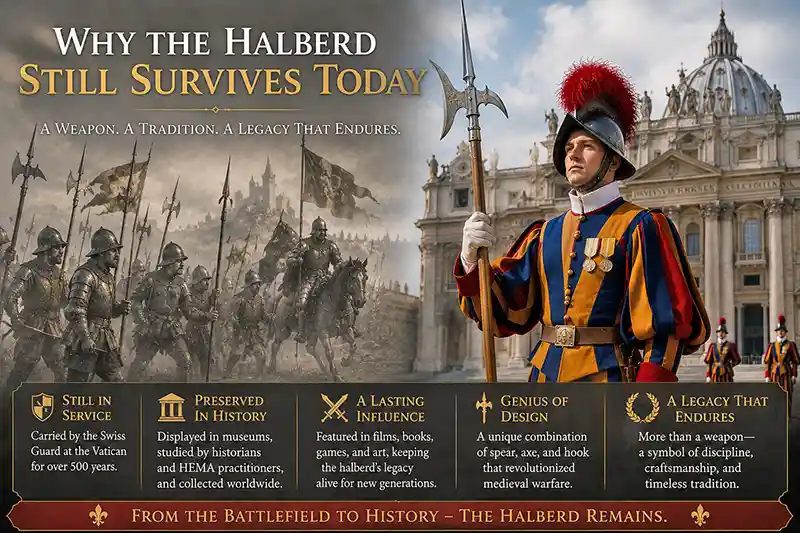
Although its days as a frontline weapon are long over, the halberd has never truly disappeared. One of the most famous examples can still be seen at the Vatican, where the Swiss Guard continues to carry halberds during ceremonial duties. Their colorful uniforms and distinctive polearms preserve a tradition that stretches back more than five centuries, making the halberd one of the few medieval weapons that remains in official service today.
Beyond ceremonial use, the halberd continues to fascinate historians, collectors, martial artists, and reenactors. Museums around the world display original examples, while historical European martial arts (HEMA) practitioners study surviving manuals to understand how these remarkable weapons were actually used. Modern reproductions have also become popular with collectors who appreciate the halberd's unique combination of elegance and battlefield practicality.
Its influence extends beyond history as well. The halberd appears in countless movies, fantasy novels, television series, and video games, although fictional versions are often exaggerated or redesigned for dramatic effect. Even so, the real weapon remains impressive enough on its own. Its ingenious combination of spear, axe, and hook helped reshape medieval warfare and secured its place among history's greatest polearms.
For a weapon that was designed to solve the practical problems of medieval combat, the halberd has enjoyed an extraordinary legacy. Long after armies stopped carrying it into battle, its unmistakable silhouette continues to symbolize discipline, craftsmanship, and one of the most innovative weapon designs ever created.
The Weapon That Changed Medieval Warfare Forever
The halberd never achieved the legendary status of the sword, yet it accomplished something far more important. It gave disciplined infantry a weapon capable of standing against armored knights, mounted cavalry, and a constantly changing battlefield. By combining the reach of a spear, the cutting power of an axe, and the control of a hook, it solved problems that no single weapon could address on its own.
Its success influenced military tactics across Europe, helped elevate the importance of professional foot soldiers, and proved that battlefield victories depended on organization and innovation as much as individual bravery. Even after gunpowder rendered it obsolete as a frontline weapon, the halberd remained a symbol of military excellence, surviving in ceremonial service long after countless other medieval weapons had disappeared.
Today, the halberd stands as one of history's greatest examples of practical weapon design. It may not receive the same attention as famous medieval swords, but few weapons had a greater impact on the outcome of battles or the evolution of warfare. For centuries, the halberd proved that the smartest weapon was not always the most famous one.
What Is the Difference Between a Halberd and a Poleaxe?
Although they look similar, the halberd and the poleaxe were designed for different users and different styles of combat. The halberd was primarily an infantry weapon, carried by foot soldiers fighting in large formations. Its long shaft gave it excellent reach, allowing halberdiers to keep cavalry at a distance, hook riders from their horses, and strike enemies before they could close in.
The poleaxe, on the other hand, was often associated with armored knights and men-at-arms fighting on foot. It was typically shorter than a halberd, making it easier to control in close combat. Many poleaxes featured a hammer face, axe blade, spear point, and rear spike, creating a compact weapon designed specifically for fighting heavily armored opponents in duels or the chaos of melee combat.
Both weapons were exceptionally effective, but the halberd excelled on the battlefield as a formation weapon, while the poleaxe was better suited to individual combat between heavily armored warriors.
Why Was the Halberd Better Than a Spear?
The halberd wasn't necessarily better than a spear in every situation, but it was far more versatile. A spear excelled at thrusting attacks and keeping enemies at a distance, making it one of history's simplest and most effective battlefield weapons. However, once an opponent closed the gap or wore heavy armor, the spear's options became much more limited.
The halberd solved that problem by combining several weapons into one. Its spear point could still thrust like a traditional spear, but its axe blade delivered powerful chopping blows, while the rear hook could pull riders from horseback, snag shields, or unbalance opponents. This gave halberdiers more ways to adapt as a battle changed, making the weapon especially valuable in close combat and against armored enemies.
For armies that needed a dedicated formation weapon, the spear remained an excellent choice. But when flexibility mattered, the halberd became one of the most capable polearms ever carried onto a medieval battlefield.
Did Knights Ever Use Halberds?
Yes, although the halberd is most closely associated with infantry, some knights and men-at-arms also used it, particularly when fighting on foot. During sieges, defensive battles, or situations where cavalry was impractical, a halberd offered excellent reach and the ability to thrust, chop, and hook heavily armored opponents. It was especially useful in the crowded conditions of castle assaults and narrow streets where mounted combat was impossible.
That said, the halberd was never as closely linked to knights as weapons like the sword, lance, or poleaxe. Its greatest success came in the hands of disciplined infantry formations, where groups of trained soldiers could combine their weapons to stop cavalry and overwhelm armored enemies. This is why the halberd is remembered primarily as the weapon that helped ordinary foot soldiers challenge Europe's most powerful mounted warriors.
How Heavy Was a Typical Halberd?
Most historical halberds weighed between 5 and 8 pounds (2.3 to 3.6 kg), although larger battlefield and ceremonial versions could weigh more. While that may sound heavy, the weapon's long wooden shaft distributed its weight well, allowing trained soldiers to thrust, chop, and hook with surprising speed and control. It was designed for efficiency rather than brute force.
A halberd that was too heavy would quickly exhaust its user during a prolonged battle. Medieval weapon makers understood this, carefully balancing the steel head and wooden shaft to create a weapon that was powerful enough to defeat armored opponents while remaining practical to carry and use for extended periods. Its effectiveness came from leverage, reach, and technique just as much as its weight.
Could the Halberd Pierce Plate Armor?
Sometimes, but that was not its primary purpose. The spear point on a halberd could penetrate weaker areas of armor or exploit gaps around the visor, armpits, elbows, and other joints. Against high-quality plate armor, however, completely piercing the steel was difficult. Medieval soldiers instead relied on the halberd's combination of thrusting, chopping, and hooking attacks to create openings and disable an opponent.
The axe blade could deliver powerful blows against helmets and limbs, while the rear hook could pull a knight from horseback or drag an opponent off balance. Once an armored fighter was on the ground, the halberd's reach and multiple striking surfaces gave its wielder a significant advantage. Like the war hammer, the halberd was designed to defeat the person wearing the armor, not simply cut through the armor itself.
Why Did the Swiss Guard Keep the Halberd When Everyone Else Abandoned It?
The Swiss Guard kept the halberd because its role changed from a battlefield weapon to a ceremonial symbol. Founded in 1506, the Vatican's Swiss Guard preserved many of the traditions, uniforms, and weapons of the elite Swiss mercenaries who were once among Europe's most respected soldiers. While firearms eventually replaced halberds in combat, the weapon remained an important emblem of discipline, honor, and military heritage.
Today, Swiss Guards still carry beautifully crafted halberds during official ceremonies and while standing watch at the Vatican. Although modern security relies on contemporary equipment, the halberd continues to represent more than five centuries of continuous tradition, making it one of the few medieval weapons still carried in official service anywhere in the world.
Was the Halberd Difficult to Learn?
Compared to many medieval weapons, the halberd was relatively straightforward to learn. While mastering it required discipline and regular training, new soldiers could become effective much more quickly than someone learning advanced swordsmanship. Its long reach and simple thrusting techniques made it well suited for fighting in organized formations where teamwork mattered more than individual dueling skill.
Experienced halberdiers, however, developed a much wider range of techniques. They learned to switch seamlessly between thrusting with the spear point, chopping with the axe blade, hooking opponents or weapons with the rear spike, and using the shaft to control distance. In the hands of a veteran soldier, the halberd became one of the most versatile and effective weapons on the medieval battlefield.
Did the Halberd Replace the Pike?
No. In fact, the two weapons often worked together on the same battlefield. The pike's extraordinary length made it ideal for stopping cavalry charges and keeping enemy formations at a distance. Halberds, which were shorter and more versatile, became most effective once the fighting moved into close quarters after the pike formations had disrupted the enemy.
Many famous infantry armies equipped the majority of their soldiers with pikes while assigning halberds to experienced troops, officers, or soldiers positioned within the formation. The pike created the wall of defense, while the halberd provided the flexibility needed when enemies broke through or the battle became too crowded for extremely long weapons. Rather than replacing one another, the pike and halberd complemented each other and helped make late medieval infantry some of the most formidable forces in Europe.
Why Didn't Every Army Use Halberds?
The halberd was an outstanding weapon, but it was not the perfect solution for every army or every battlefield. It required disciplined formations, regular training, and enough room to use its long shaft effectively. Armies that relied heavily on cavalry, archers, or early firearms often found other weapons better suited to their tactics.
Regional traditions also played a role. Different cultures developed weapons that matched their own armor, terrain, and methods of warfare. While the halberd became one of Europe's greatest polearms, other civilizations favored weapons that accomplished similar goals in different ways. The best weapon was usually the one that fit the army using it.
Could a Halberd Really Stop a Charging Horse?
Yes, but usually not by killing the horse outright. The halberd's long reach allowed soldiers to threaten an approaching rider before the horse reached them. A disciplined formation of halberdiers could force cavalry to slow, turn aside, or lose momentum, greatly reducing the effectiveness of a charge.
The weapon's hook also gave soldiers another advantage. If a mounted knight came within reach, halberdiers could catch armor, reins, or equipment and pull the rider off balance. Combined with neighboring soldiers, these tactics made cavalry charges far more dangerous for the attackers than many people imagine.
Why Was the Halberd So Effective Against Cavalry?
The halberd attacked cavalry in several different ways at once. Its spear point threatened both horse and rider from a distance, the axe blade could strike once the enemy closed in, and the rear hook could snag armor or pull a rider from the saddle. Few medieval weapons offered so many options in a single design.
Equally important was the way halberdiers fought together. A cavalry charge that might overwhelm an individual soldier often failed against a disciplined wall of polearms working as one unit. The halberd's greatest strength was not just the weapon itself, but the formation behind it.
Did Samurai Ever Use Weapons Like the Halberd?
Not exactly, but Japan developed several polearms that served similar battlefield roles. The naginata combined exceptional reach with a curved cutting blade, while the yari emphasized powerful thrusting attacks. Both became highly effective weapons for organized infantry and mounted warriors.
Unlike the halberd, however, neither weapon featured the distinctive rear hook that made the European design so versatile against armored cavalry. Although their shapes differed, all three weapons demonstrate how different cultures reached similar solutions for fighting at longer range.
What Is the Difference Between a Halberd and a Glaive?
A glaive is essentially a long pole fitted with a single-edged blade, making it function much like an oversized sword on a shaft. It excelled at sweeping cuts and powerful slashing attacks but lacked the additional features found on a halberd.
The halberd combined a spear point, an axe blade, and a rear hook into one weapon. This allowed it to thrust, chop, hook, and pull opponents, making it considerably more versatile on medieval battlefields. Although the two weapons are often confused, they were designed with different priorities in mind.
Were Halberds Used in Castle Sieges?
Yes. The halberd proved especially useful during sieges, where soldiers fought in narrow gateways, on walls, and across ladders or barricades. Its long reach allowed defenders to strike attackers before they reached the walls, while its hook could pull scaling ladders, shields, or enemy soldiers out of position.
Inside a breached castle, the weapon remained effective because it could adapt quickly to changing conditions. Whether thrusting down a corridor or chopping at armored opponents in confined spaces, the halberd gave defenders a flexible weapon for some of the fiercest fighting of the Middle Ages.
Could One Person Defeat Several Soldiers with a Halberd?
Probably not, despite what movies and video games often suggest. The halberd was designed to be used alongside other soldiers in disciplined formations, not as a weapon for lone heroes. Its greatest advantages came from coordinated teamwork, overlapping reach, and mutual support.
A highly skilled fighter could certainly hold opponents at bay for a time, but facing multiple trained enemies was dangerous regardless of the weapon. The halberd became legendary because thousands of ordinary soldiers used it together, not because it turned individuals into unstoppable warriors.
Why Didn't the Halberd Become Popular Outside Europe?
Different civilizations developed polearms that suited their own military traditions. In Japan, the yari and naginata became dominant. China relied on a wide variety of spears and polearms, while other regions favored weapons shaped by local armor, tactics, and terrain.
Rather than spreading worldwide, the halberd remained a distinctly European solution to European battlefield problems. Its combination of spear, axe, and hook was ideal for fighting armored knights, but other cultures often faced different challenges and created different weapons to solve them.
Were Halberds Ever Used at Sea?
Yes. Boarding actions during the late medieval and Renaissance periods often involved polearms, including halberds. On the cramped decks of ships, sailors and marines could use the weapon's reach to keep enemies at a distance or its hook to pull opponents closer during hand-to-hand fighting.
Although shorter weapons eventually became more practical aboard many vessels, the halberd remained useful during an era when naval battles frequently ended with one crew boarding another. Its versatility translated surprisingly well from the battlefield to the deck of a warship.
What Is the Largest Halberd Ever Made?
There is no single officially recognized "largest halberd" in history, but some ceremonial examples grew to enormous sizes. Palace guards and royal bodyguards occasionally carried oversized halberds with exceptionally long shafts and elaborate heads that emphasized prestige more than battlefield practicality.
These ceremonial weapons were never intended to outperform standard military halberds. In real combat, excessive size became a disadvantage. The most successful battlefield halberds were those that balanced reach, strength, and maneuverability, proving once again that effective weapon design was usually a matter of smart engineering rather than sheer scale.
You May Also Be Interested In:
- A Brief History of Kung Fu
- A Brief History of Judo
- The Strange History of the Blowgun
- What Is a Kusarigama? History, Uses, and Training Basics
- The History of the Medieval Flail Weapon
- What Is a Three Section Staff? History, Uses & How It Works
- The Different Types of Spears Used in History (And What Made Each One Deadly)
- The Most Intimidating Weapons in History (And Whether They Deserved Their Reputation)
- The Real History of the Jutte (And Why Samurai Carried It)
- What Is the Best Sword of All Time? A Look at History's Greatest Blades
Leave a Reply