




The History of the Bec de Corbin: The Raven Beak That Defeated Plate Armor
August 7th, 2026
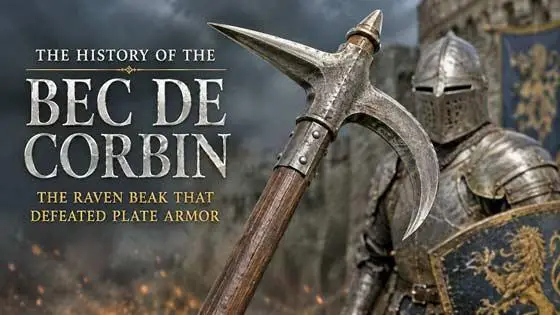
The bec de corbin was one of the most specialized anti-armor weapons ever developed, yet few people today recognize its name. Translating to "raven's beak" in French, this formidable pole weapon featured a sharply curved steel spike designed to concentrate enormous force onto a tiny point. Rather than slicing through armor, it was built to dent, puncture, and exploit the weak spots in a knight's defenses with ruthless efficiency. As plate armor reached its peak during the late Middle Ages, the bec de corbin evolved alongside it, becoming one of the most feared weapons carried by knights and professional men-at-arms. Its distinctive hooked profile and devastating effectiveness earned it a lasting place among history's greatest medieval weapons.
What Is a Bec de Corbin?
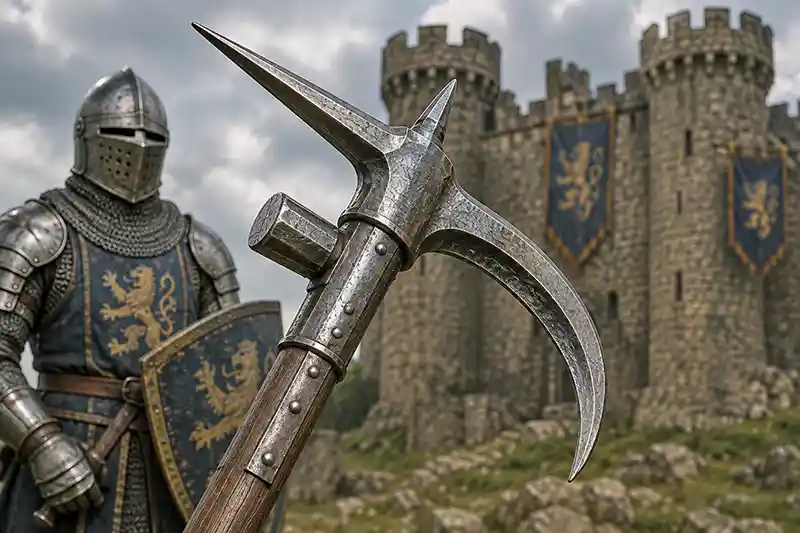
The bec de corbin was a specialized medieval pole weapon developed to fight heavily armored opponents during the late Middle Ages. Its name comes from the French phrase meaning "raven's beak," a reference to the sharply curved steel spike that gave the weapon its distinctive appearance. Unlike broad axe blades that relied on cutting power, the bec de corbin's hooked beak concentrated tremendous force onto a tiny point, making it exceptionally effective against plate armor.
Most examples combined several offensive features into a single weapon. Opposite the curved beak was usually a hammer face designed to deliver crushing blows, while a long spear-like spike extended from the top for thrusting attacks. Mounted on a sturdy wooden shaft reinforced with steel langets, the weapon gave its user the reach of a polearm while offering multiple ways to attack an armored opponent.
Although it is sometimes confused with the poleaxe, the bec de corbin placed much greater emphasis on armor penetration than chopping power. Many versions featured only a small axe blade or none at all, instead relying on the raven-like beak and hammer to damage armor, puncture weak points, and unbalance opponents. It was purpose-built for an era when swords alone were no longer enough to defeat the finest plate armor.
By the 15th century, the bec de corbin had earned a reputation as one of the most formidable anti-armor weapons in Europe. Its ingenious design reflected the constant contest between offensive weapons and defensive armor, making it one of the most specialized and effective tools ever carried by knights and professional men-at-arms.
Why the Raven Beak Was So Deadly
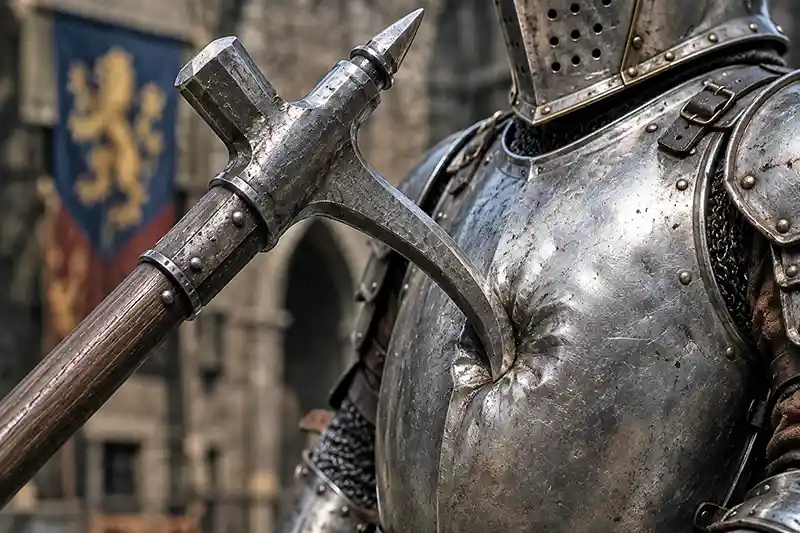
The defining feature of the bec de corbin was the narrow, curved spike that gave the weapon its name. Unlike a broad axe blade, which spread force across a larger surface, the raven-like beak focused almost all of the impact onto a tiny point. That concentration of force made it especially dangerous against helmets, breastplates, and other hardened armor.
The goal was not always to punch completely through the steel. A powerful strike could dent plate, damage joints, and transmit enough force to injure the person underneath. If the beak caught a thinner section of armor or a gap between plates, it could become even more devastating.
The curved shape also made the weapon useful for control. A fighter could hook an opponent's shield, limb, or equipment and pull them off balance before following with another strike. Against a heavily armored enemy, that ability to manipulate position was just as important as raw striking power.
This combination of penetration, impact, and control is what separated the bec de corbin from simpler hammers. It was a highly specialized answer to the problem of plate armor, and its design reflects just how sophisticated medieval anti-armor weapons had become.
Designed to Defeat Plate Armor
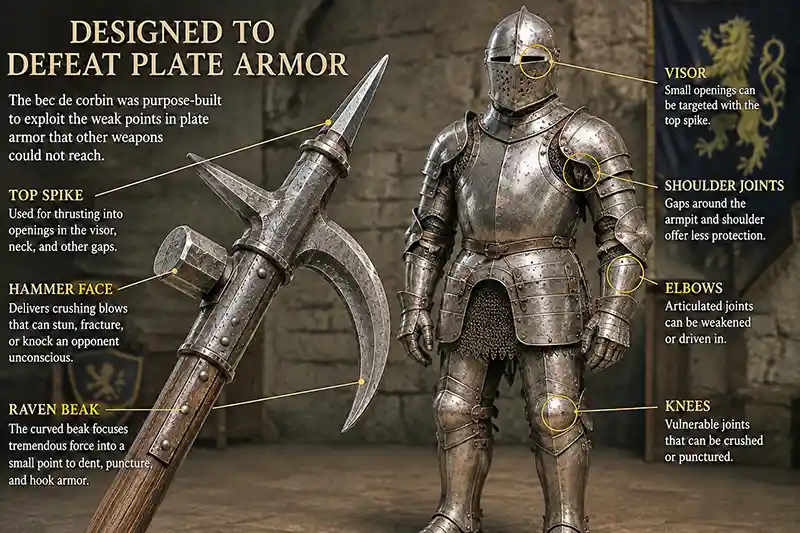
The bec de corbin emerged at exactly the right moment in medieval warfare. By the 15th century, plate armor had become remarkably effective at stopping sword cuts, glancing blows, and many conventional attacks. Warriors needed weapons that could concentrate force into smaller areas, and the bec de corbin was built specifically for that challenge.
Its hammer face could deliver heavy blunt trauma even when the armor itself remained intact, while the curved beak focused impact onto a narrow point that could dent or puncture weaker sections of plate. The top spike gave the wielder another option for thrusting into openings around the visor, neck, armpits, and joints, where even the best armor offered less protection.
This made the weapon especially dangerous in close combat between heavily armored fighters. Rather than wasting energy trying to cut through solid steel, the user could target vulnerable areas, disrupt an opponent's balance, and use leverage to create openings for follow-up strikes. The weapon rewarded precision just as much as strength.
Its design places it in the same family of specialized anti-armor weapons as the war hammer, but the longer shaft gave the bec de corbin greater reach and leverage. It was a clear example of medieval weapon makers adapting directly to improvements in armor, turning defense into the inspiration for an even more specialized offense.
How Knights Used the Bec de Corbin in Combat
The bec de corbin was most effective in the hands of a trained fighter who understood how to control distance and exploit openings in armor. Its long shaft gave the wielder more reach than a sword or short war hammer, allowing knights and men-at-arms to threaten an opponent before the fight collapsed into grappling range.
A typical attack might begin with a thrust from the top spike, forcing the opponent to react or shift their guard. From there, the fighter could rotate the weapon and strike with the hammer face, hook with the curved beak, or use the shaft to shove and unbalance the opponent. The ability to attack from multiple angles made the weapon especially dangerous in one-on-one armored combat.
The beak itself could also be used tactically rather than purely as a striking point. A fighter could catch armor, limbs, or equipment and use the weapon as a lever to pull an opponent off balance. Once the enemy stumbled or exposed a weak point, the hammer or spike could follow immediately.
This made bec de corbin combat far more technical than simply swinging a heavy weapon. Like the fighting methods used with the poleaxe, success depended on timing, leverage, footwork, and control. In skilled hands, the weapon became a system for dominating armored opponents rather than just a tool for delivering powerful blows.
Bec de Corbin vs Poleaxe
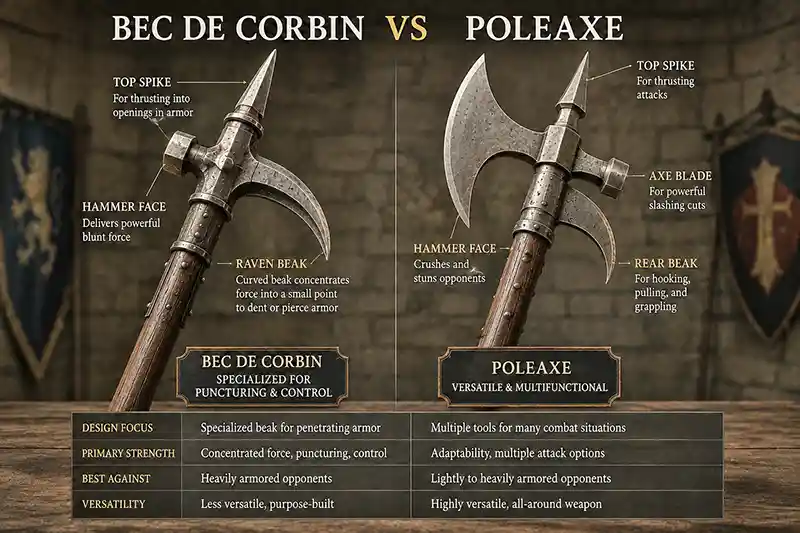
The bec de corbin and the poleaxe are often grouped together because both were built for armored combat, but their designs reveal different priorities. The poleaxe was the more versatile weapon, typically combining an axe blade, hammer face, top spike, and rear beak. It could chop, crush, thrust, hook, and grapple, making it exceptionally adaptable in duels and close combat.
The bec de corbin was more specialized. Its defining feature was the long, curved raven beak designed to concentrate force into a tiny impact point. Rather than relying on a broad axe blade, it emphasized puncturing, denting, and controlling armored opponents. The hammer face on the opposite side added blunt-force capability, while the top spike provided a direct thrusting option.
In practical terms, the poleaxe gave a fighter more overall flexibility, while the bec de corbin focused more aggressively on defeating plate armor. Both rewarded precision, timing, and leverage, but the bec de corbin's narrower purpose made it especially effective when the opponent was heavily protected.
That difference also explains why the two weapons can look similar at first glance yet behave very differently in combat. The poleaxe was a multifunctional system. The bec de corbin was a specialist built around one brutal idea: concentrate as much force as possible into the weakest point in the armor.
How the Bec de Corbin Evolved Across Europe
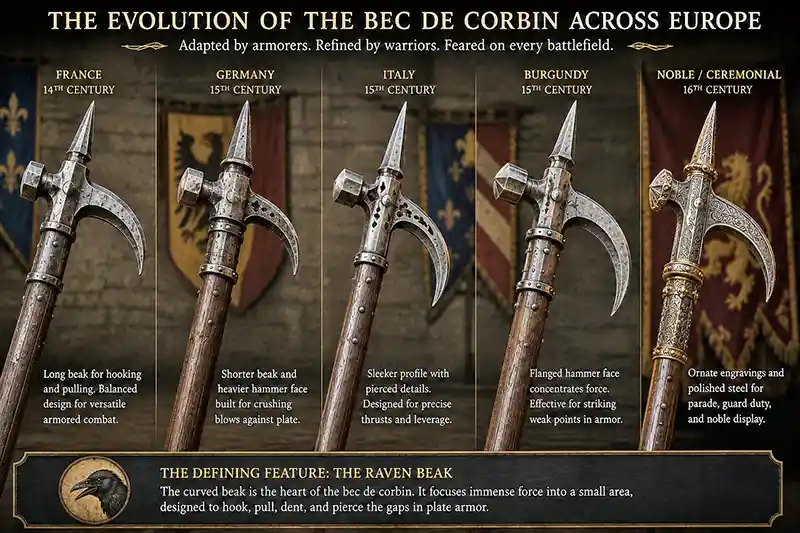
The bec de corbin did not appear in one perfectly standardized form. As it spread through late medieval Europe, armorers adapted the weapon to local fighting styles, available materials, and changing armor designs. Some versions featured longer, more dramatically curved beaks, while others used shorter, thicker spikes built to deliver heavier impacts against plate.
The hammer face also varied. Certain examples used a broad, flat striking surface, while others incorporated flanges or faceted heads that concentrated force into smaller areas. The top spike could be long and spear-like or relatively compact, depending on whether the weapon emphasized thrusting, hooking, or crushing attacks.
These regional differences reveal how specialized the weapon had become. Armorers were not simply copying a popular design. They were refining it in response to practical combat experience, just as they had with the halberd and other advanced polearms. Every change in the head, shaft, and reinforcement reflected a different approach to defeating armored opponents.
By the height of the Renaissance, some bec de corbin designs had become highly ornate as well as functional. Engraved steel, decorative cutouts, and polished surfaces appeared on weapons made for nobles, guards, and ceremonial use. Even then, the unmistakable raven-beak profile remained the defining feature that set the weapon apart.
Why the Bec de Corbin Eventually Disappeared

The bec de corbin was created for a very specific battlefield problem: defeating heavily armored opponents. Once that problem began to disappear, so did the weapon. By the 16th century, firearms were becoming increasingly powerful and reliable, making even the finest plate armor less useful against gunpowder weapons.
As armor declined, specialized anti-armor weapons lost much of their purpose. Armies shifted toward pikes, muskets, and other weapons that fit the new style of warfare. A bec de corbin still remained dangerous in close combat, but it no longer offered the same tactical advantage it had enjoyed during the height of plate armor.
Military organization was changing as well. Large professional armies favored weapons that could be standardized, produced in greater numbers, and taught to soldiers quickly. The bec de corbin required more specialized training and made the most sense in a world dominated by armored elites fighting at close range.
Its disappearance was not a sign of failure. Like many of the weapons that proved more effective than swords, it simply belonged to a particular moment in military history. Once that moment passed, the weapon that had been perfectly adapted to plate armor became a relic of an older style of war.
The Legacy of the Bec de Corbin
Although the bec de corbin disappeared from active military use, its design left a lasting mark on the history of medieval weapons. It represented the peak of a centuries-long arms race between armorers trying to protect the human body and weapon makers searching for new ways to defeat that protection. Few weapons illustrate that competition as clearly as the bec de corbin.
Its combination of a hammer, thrusting spike, and raven-like beak showed just how specialized late medieval combat had become. Instead of relying on a single type of attack, the weapon gave skilled fighters several ways to exploit an armored opponent. That same philosophy can be seen in other advanced polearms and anti-armor weapons from the period.
Today, surviving examples are prized by museums, collectors, and historical martial arts researchers because they reveal both sophisticated engineering and the brutal realities of armored combat. Their unusual shape also makes them immediately recognizable, even among the many strange and elaborate weapons of the Middle Ages.
The bec de corbin may never have achieved the fame of the sword, but its importance comes from something more practical. It was a weapon created for a specific problem, refined with remarkable precision, and used during one of the most technologically advanced periods of medieval warfare. That makes the raven beak one of the clearest examples of how innovation often begins with necessity.
Why the Bec de Corbin Still Fascinates Historians Today
Few medieval weapons tell the story of technological innovation as clearly as the bec de corbin. Every curve, spike, and striking surface existed for a reason. Rather than relying on brute force alone, the weapon reflected centuries of experimentation as armorers and weapon makers continuously adapted to one another's advances. It stands as proof that medieval warfare was far more sophisticated than many people imagine.
Modern historians, museum curators, and historical European martial arts practitioners continue to study surviving examples because they reveal how knights actually fought during the age of plate armor. Original weapons, period artwork, and surviving combat manuals all point to the bec de corbin as one of the most refined anti-armor weapons ever created. Its effectiveness came from precision, leverage, and versatility rather than sheer size or weight.
While the sword remains the iconic symbol of the Middle Ages, weapons like the bec de corbin often determined the outcome when heavily armored warriors met on the battlefield. It may never have achieved the same legendary reputation, but among those who study medieval arms, the raven beak remains one of history's most ingenious and specialized battlefield weapons.
Frequently Asked Questions About the Bec de Corbin
The bec de corbin is one of the most misunderstood medieval weapons, largely because it is often confused with the poleaxe, war hammer, and other anti-armor polearms. Below are answers to some of the most common questions about its history, design, and use in medieval warfare.
What Does Bec de Corbin Mean?
The name bec de corbin is French for "raven's beak." It refers to the weapon's distinctive curved steel spike, which resembles the hooked beak of a raven. That shape was not simply decorative. It allowed the weapon to concentrate tremendous force onto a very small point, making it highly effective for denting armor, catching equipment, and exploiting weak spots in plate armor.
The name perfectly reflects the weapon's purpose. Just as a raven uses its beak to grip and tear, the bec de corbin was designed to hook, pull, puncture, and control an opponent rather than relying on broad cutting attacks. Its unique profile remains one of the easiest ways to distinguish it from other medieval polearms.
Was the Bec de Corbin Better Than a Sword?
It depended on the opponent. Against an unarmored enemy, a sword was often faster, lighter, and more versatile for cutting and thrusting. Against a knight wearing full plate armor, however, the bec de corbin usually had the advantage. Its hammer face, raven beak, and top spike were specifically designed to overcome defenses that swords struggled to penetrate.
Rather than trying to slice through steel, the bec de corbin concentrated force onto weak points in the armor, denting plate, targeting gaps, and using leverage to throw an opponent off balance. This made it one of the most effective anti-armor weapons of the late Middle Ages, while the sword remained the preferred sidearm for many other combat situations.
Did Knights Actually Carry Bec de Corbins Into Battle?
Yes. Although not as common as swords or lances, the bec de corbin was carried by knights and professional men-at-arms during the late Middle Ages when fighting heavily armored opponents. It was especially valuable once mounted combat gave way to brutal fighting on foot, where its reach and specialized armor-defeating design could be fully exploited.
The weapon was also used in tournaments and judicial duels, where armored combat often mirrored real battlefield conditions. Because it required skill, strength, and precise technique, the bec de corbin became closely associated with experienced warriors who trained extensively in the use of advanced polearms rather than ordinary infantry weapons.
Could a Bec de Corbin Pierce Plate Armor?
Sometimes, but not usually by punching straight through the thickest parts of a breastplate. The bec de corbin was designed to concentrate enormous force onto a tiny point, allowing it to dent armor, damage helmets, and exploit thinner areas or gaps around the visor, neck, armpits, elbows, and knees. A precise strike against one of these vulnerable locations could be devastating.
Its real strength was not brute penetration but versatility. If the curved beak failed to find an opening, the fighter could immediately switch to the hammer face for a crushing blow or use the top spike for a thrust. This ability to combine different attacks made the bec de corbin one of the most effective anti-armor weapons ever developed, even without cutting through solid plate.
What Is the Difference Between a Bec de Corbin and a War Hammer?
The bec de corbin and the war hammer shared the same goal of defeating heavily armored opponents, but they approached that task differently. A traditional war hammer was a shorter one-handed or two-handed weapon built around a hammer face and armor-piercing spike. The bec de corbin mounted similar striking surfaces on a much longer pole, giving the wielder significantly greater reach and leverage.
That extra reach made the bec de corbin especially effective for controlling distance, hooking opponents off balance, and delivering powerful attacks before an enemy could close in. While both weapons excelled against plate armor, the war hammer was often favored as a compact sidearm, whereas the bec de corbin functioned as a specialized polearm for heavily armored combat on foot.
Did the Bec de Corbin Replace the Poleaxe?
No. The bec de corbin and the poleaxe existed alongside one another because they filled slightly different roles in armored combat. The poleaxe was generally the more versatile weapon, combining an axe blade, hammer face, top spike, and often a rear beak into a single design. The bec de corbin focused more heavily on armor penetration and control, emphasizing its distinctive hooked beak and hammer rather than chopping power.
Many knights and men-at-arms chose their weapon based on personal preference, fighting style, and the type of combat they expected to face. Neither weapon replaced the other. Instead, they represent two of the most sophisticated solutions ever developed for defeating plate armor during the late Middle Ages.
Was the Bec de Corbin Used on Horseback?
Generally, no. The bec de corbin was designed primarily for fighting on foot, where its long shaft could be used to thrust, hook, and control heavily armored opponents. While a mounted knight could technically carry one, its length made it less practical than a lance during a cavalry charge.
The typical sequence of combat was for a knight to charge with a lance and then continue the fight on foot if unhorsed or once the battle became a close-quarters melee. In those situations, the bec de corbin came into its own, offering the reach, leverage, and specialized anti-armor features needed to fight other armored warriors effectively. It was a weapon built for the brutal hand-to-hand combat that often followed the initial clash of cavalry.
How Heavy Was a Typical Bec de Corbin?
Despite its intimidating appearance, most bec de corbins weighed between 5 and 7 pounds (2.3 to 3.2 kg). Medieval armorers carefully balanced the weapon so it delivered tremendous striking power without becoming too slow or exhausting to wield. The long wooden shaft provided excellent leverage, allowing skilled fighters to generate force through technique rather than sheer strength alone.
A well-balanced bec de corbin was designed for repeated attacks, quick recoveries, and smooth transitions between thrusting, hooking, and hammering. Making the weapon excessively heavy would have reduced its speed and control, so medieval craftsmen focused on achieving the ideal balance between power, reach, and maneuverability instead of simply adding more weight.
Why Is the Bec de Corbin Often Confused With the Poleaxe?
The confusion comes from the fact that both weapons were designed for armored combat and share several visual features. Each typically includes a hammer face, a top spike, and a long wooden shaft, making them appear very similar at first glance. In museums, illustrations, and even modern books, the two are sometimes mislabeled because the differences can be subtle.
The easiest way to tell them apart is to look for the axe blade. A true poleaxe usually features a prominent axe head paired with a hammer or rear beak, while the bec de corbin replaces that broad cutting blade with its distinctive hooked "raven's beak" spike. That design reflects the bec de corbin's greater emphasis on puncturing, hooking, and defeating plate armor rather than chopping. Although closely related, they are separate weapons developed for slightly different approaches to armored combat.
Did Different Countries Build Different Types of Bec de Corbin?
Yes. Like many medieval weapons, the bec de corbin evolved differently across Europe as armorers refined the design to suit local fighting styles and military traditions. French examples often emphasized the distinctive curved beak that gave the weapon its name, while German and Italian versions sometimes featured longer thrusting spikes, heavier hammer faces, or subtle changes to the shape of the hook. The length of the shaft and decorative details also varied from region to region.
Despite these differences, the weapon's purpose remained the same. Whether forged in France, Germany, Italy, or elsewhere in Europe, every bec de corbin was designed to concentrate force against heavily armored opponents. The regional variations reflect centuries of practical refinement rather than entirely different weapons, showing how medieval craftsmen continually improved one of history's most specialized anti-armor polearms.
Was the Bec de Corbin the Best Weapon Against Plate Armor?
Many historians consider the bec de corbin one of the finest anti-armor weapons ever created, but whether it was the absolute best depends on the situation. Weapons such as the poleaxe, war hammer, and estoc were all designed to defeat heavily armored opponents, each with its own strengths. The bec de corbin excelled by combining reach, leverage, crushing power, and a hooked beak capable of exploiting weak points in armor.
Rather than relying on a single method of attack, it allowed a skilled fighter to thrust, hammer, hook, and control an opponent from a distance. That versatility made it exceptionally effective in armored combat and explains why many experts regard it as one of the greatest knightly weapons of the late Middle Ages.
What Is the Difference Between a Bec de Corbin and a Lucerne Hammer?
The bec de corbin and the Lucerne hammer are closely related polearms, but they developed as distinct weapons. A bec de corbin is identified by its curved "raven's beak" hook paired with a hammer face, while a Lucerne hammer typically features a longer, straighter armor-piercing spike opposite a multi-pronged hammer head. The Lucerne hammer placed greater emphasis on puncturing armor, whereas the bec de corbin balanced piercing, hooking, and control.
Both weapons were highly effective against plate armor and appeared during the late Middle Ages, which is why they are often confused. In practice, they shared many fighting techniques, but their head designs reveal different approaches to solving the same battlefield problem.
Could a Bec de Corbin Break a Shield?
Yes, especially if the shield was made primarily of wood. The hammer face could crack boards and loosen metal fittings, while the hooked beak could catch the edge of a shield and pull it aside. Even when the shield remained intact, repeated impacts could make it difficult for an opponent to defend effectively.
Against stronger shields, experienced fighters often preferred to use the hook to manipulate the shield rather than destroy it outright. Pulling a shield out of position often created a better opportunity than trying to smash through it.
Did Medieval Combat Manuals Teach the Bec de Corbin?
Yes. Although many manuals refer more generally to polearms or armored combat, the techniques they illustrate closely match weapons such as the bec de corbin. Masters including Fiore dei Liberi and Hans Talhoffer documented thrusts, hooks, strikes, grappling, and disarming techniques that were perfectly suited to this type of weapon.
These surviving manuscripts have become invaluable resources for historians and HEMA practitioners. They show that the bec de corbin was not simply swung like a heavy club. It was used with precision, leverage, and carefully timed movements that required considerable training to master.
Was the Bec de Corbin Ever Used Outside Europe?
The bec de corbin is considered a European weapon, developing during the late Middle Ages in response to advances in European plate armor. While other cultures created their own polearms and armor-piercing weapons, they generally followed different design traditions and evolved independently.
Because the bec de corbin was closely tied to European armor and battlefield tactics, it never became a widespread weapon outside the continent. Its unique shape reflects the specific military challenges faced by European knights and men-at-arms during the 14th through 16th centuries.
Are Original Bec de Corbins Rare Today?
Yes. Authentic medieval bec de corbins are relatively uncommon because many were lost in war, damaged beyond repair, or melted down once they became obsolete. Steel was valuable, and old weapons were often recycled into new tools or military equipment rather than preserved.
The surviving examples are now treasured by museums and private collectors. They provide valuable evidence of medieval craftsmanship and continue to help historians understand how armored combat evolved during the final centuries of the Middle Ages.
What Wood Was Used for Bec de Corbin Shafts?
Most bec de corbin shafts were made from durable hardwoods such as ash, which was prized for its combination of strength, flexibility, and relatively light weight. A properly seasoned ash shaft could absorb powerful impacts without breaking while remaining responsive in the hands of a skilled fighter.
Many shafts were reinforced with long steel langets that protected the wood from enemy blades. These reinforcements helped ensure the weapon remained functional even after repeated strikes against armor and other polearms.
Could a Bec de Corbin Pull a Rider Off a Horse?
Potentially, yes. The weapon's hooked beak was capable of catching reins, armor, or equipment, making it possible to unbalance a mounted opponent under the right circumstances. Success depended on timing, leverage, and the speed of the horse, so it was far from guaranteed, but the hook offered opportunities that straight weapons did not.
More commonly, the bec de corbin was used after mounted combat had broken down and heavily armored fighters met on foot. That was the environment where its reach, hammer, spike, and hook could be used to their greatest advantage.
What Is the Difference Between a Bec de Corbin and a Military Pick?
A military pick is generally a shorter weapon, often designed to be carried as a sidearm alongside a sword or lance. It uses a pointed pick to concentrate force against armor but lacks the long reach and leverage of a polearm. The bec de corbin applies the same basic principle on a much longer shaft, allowing the user to strike, hook, and control opponents from a safer distance.
Both weapons were created to defeat plate armor, but the bec de corbin offered greater versatility because of its extended reach, hammer face, and top spike. It was essentially a more specialized battlefield evolution of the armor-piercing pick.
You May Also Be Interested In:
- The History of the Poleaxe: The Weapon That Gave Knights an Edge Against Armor
- The History of the Kendo Uniform: From Samurai Armor to Modern Training
- The History of the Halberd
- A Brief History of Kung Fu
- A Brief History of Judo
- The Strange History of the Blowgun
- What Is a Kusarigama? History, Uses, and Training Basics
- The History of the Medieval Flail Weapon
- What Is a Three Section Staff? History, Uses & How It Works
- What Is the Best Sword of All Time? A Look at History's Greatest Blades
Leave a Reply