



Why Are Throwing Axes Shaped Differently from Fighting Axes?
August 19th, 2026
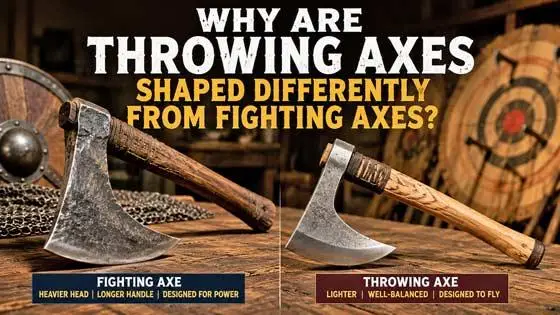
At first glance, a throwing axe and a fighting axe seem to have the same basic job: put a sharpened piece of metal on the end of a wooden handle. Look closer, however, and the differences begin to reveal two very different design problems. An axe meant to stay in the hand can be built to maximize reach, leverage, control, and the force of a blow. An axe intended to leave the hand has to remain predictable while tumbling through the air, reach its target at the right orientation, and strike with enough authority to matter. Those competing demands influenced everything from handle length and head weight to blade profile and overall balance. They also help explain why historical throwing axes such as the famous Frankish francisca can look surprisingly different from axes designed primarily for hand-to-hand combat.
An Axe That Flies Has a Completely Different Problem to Solve
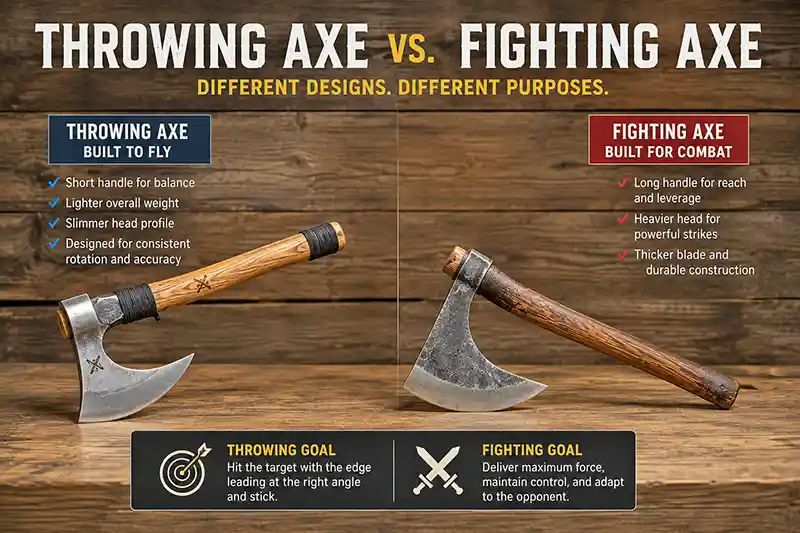
A fighting axe only has to behave predictably while it remains connected to the person swinging it. The wielder can adjust the angle of the weapon, accelerate it through the strike, change direction, recover after a miss, and use the handle itself for leverage and control. That freedom allows fighting axes to take many forms, from relatively compact one-handed weapons to long-handled axes capable of delivering tremendously powerful blows.
The instant an axe leaves the hand, nearly all of that control disappears. The weapon begins rotating around its center of mass, and the thrower has only the release to determine what happens next. Handle length, head weight, overall balance, release speed, distance, and rotation all influence whether the edge reaches the target in a useful orientation. An axe that feels excellent during a conventional swing may therefore be awkward and inconsistent when thrown.
This is why modern throwing hatchets and axes tend to favor manageable proportions and predictable balance. The goal is not simply to make an axe lighter. It is to make the entire weapon behave consistently enough that a thrower can learn its rotation and reproduce the same throw again and again.
That distinction is important because history does not divide neatly into "throwing axes" and "fighting axes." Some axes could serve both purposes, and the fact that an axe can be thrown does not mean throwing was its primary function. The most interesting designs appear where those competing requirements overlap, and few demonstrate that better than the strange axes carried by warriors more than a thousand years before recreational axe throwing existed.
Handle Length Changes What Happens After the Release
One of the easiest differences to notice between many purpose-built throwing axes and battlefield axes is the handle. A longer handle can be extremely useful when the axe remains in the hand. It increases reach and allows the wielder to generate considerable speed at the axe head during a swing. For a weapon intended primarily for close combat, those advantages can outweigh the extra length and mass.
Throwing introduces a different set of priorities. Once released, an axe rotates as a complete object rather than behaving like a blade at the end of a lever controlled by the wielder. Changing the length of the handle changes the axe's mass distribution and moment of inertia, which affects how readily it rotates. A very long handle can also make a throwing axe more cumbersome to release consistently, especially when the goal is repeated throws from known distances.
This helps explain why many modern throwing designs use relatively compact handles. A purpose-built throwing axe, for example, can be sized so that its rotation becomes predictable with practice. The thrower learns where to stand and how to release it so the blade arrives at the target rather than the handle or back of the head.
There is no single ideal handle length, however, and shorter does not automatically mean better. Historical axes intended for throwing could have proportions quite different from modern recreational designs, while some compact fighting axes were perfectly capable of being thrown when necessary. The important distinction is that a fighting axe can exploit a long handle right up until impact. A thrown axe has to carry that handle through every rotation after the wielder has already let go.
Balance Matters More Than Simply Making the Axe Light
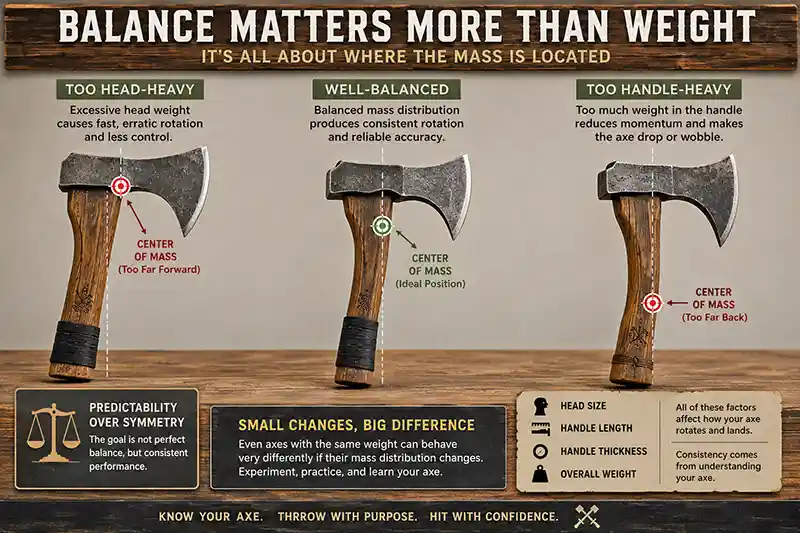
It is tempting to assume that the best throwing axe is simply the lightest axe possible. In reality, reducing weight too far can create its own problems. An axe still needs enough mass to carry momentum toward the target, and its weight has to be distributed in a way that produces consistent behavior during the throw. What matters is not just how much the axe weighs, but where that weight is located.
Most axes are naturally head-heavy because steel is far denser than wood. That imbalance is useful in a conventional swing because it concentrates mass near the striking end of the weapon. Fighting axes could take advantage of this while relying on the wielder's hands to control the head throughout the motion. A throwing axe receives no such corrections after release.
This is one reason modern throwing weapons can look deceptively simple. Small changes to head size, handle thickness, or overall length alter the distribution of mass and therefore how the object behaves in flight. Two axes of nearly identical weight can feel remarkably different if one concentrates considerably more of that weight at the head.
There is also an important misconception hidden in the idea of a "perfectly balanced" throwing axe. The goal is not necessarily to place the center of mass exactly in the physical middle of the weapon. An axe will normally remain head-heavy by design. What matters is that its mass distribution, dimensions, and release produce behavior the thrower can anticipate. Predictability is more valuable than symmetry.
The Blade Does Not Need to Be Huge to Stick
A large, intimidating blade might seem like an obvious advantage on any axe, but throwing changes the equation. Increasing the size of an axe head adds mass and alters its distribution, potentially making the entire weapon more cumbersome. A throwing axe primarily needs an edge capable of making reliable contact with the target. Making that edge dramatically larger does not automatically make the axe better at its job.
Fighting axes had different reasons for their blade shapes. Some historical examples used relatively broad cutting edges while keeping the rest of the head surprisingly thin, allowing the smith to create a large striking surface without turning the weapon into an excessively heavy lump of iron. Other fighting axes favored narrower profiles suited to the particular combat traditions and opponents for which they were intended. There was never one universal "battle axe" shape.
Modern throwing designs can take advantage of comparatively compact heads and carefully chosen edge profiles. Even unusual designs such as a double-bit throwing axe demonstrate how the geometry of a purpose-built throwing tool can differ from the familiar image of a large battlefield axe. In this case, the additional edge changes the number of orientations in which an edge can potentially meet the target, although it also changes the axe's mass distribution and handling.
This is also why judging historical axes solely by the width of their blades can be misleading. A broad blade was not necessarily extremely heavy, and a compact axe was not necessarily intended for throwing. Thickness, construction, handle length, total mass, and intended use matter just as much as the silhouette. The outline catches the eye, but the hidden distribution of material often tells us more about how an axe was meant to behave.
The Francisca Was Shaped Nothing Like a Modern Axe-Throwing Hatchet
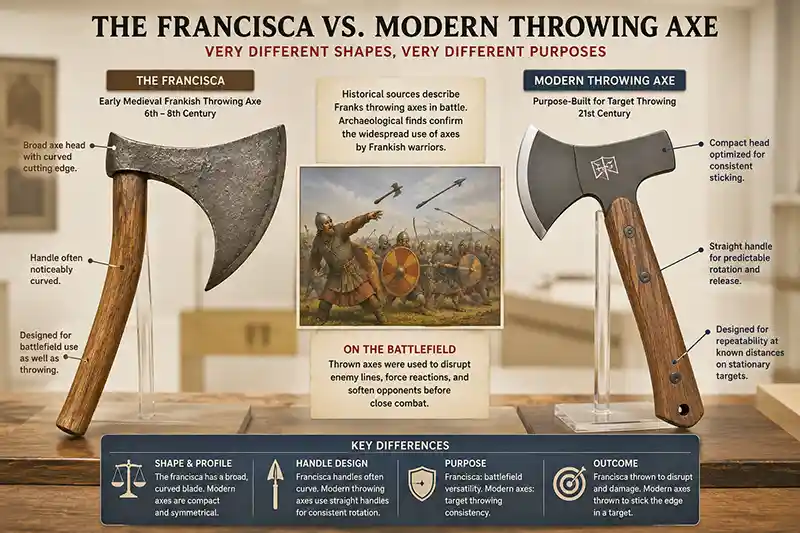
If there is one historical weapon that complicates the neat distinction between throwing axes and fighting axes, it is the francisca. Closely associated with the Franks of the early medieval period, the francisca is recognizable by its unusual profile: a relatively broad axe head with a strongly curved cutting edge, often mounted on a handle that could itself have a noticeable curve. It looks quite different from the compact, comparatively straightforward hatchets commonly seen at modern axe-throwing ranges.
Historical and archaeological evidence strongly associates these axes with Frankish warriors, while written sources describe Franks throwing axes during battle. The sixth-century historian Gregory of Tours, for example, describes axes being hurled in combat. Modern attempts to reconstruct exactly how the francisca was thrown, at what distances, and how consistently it struck are necessarily more speculative. We know far more confidently that throwing axes formed part of Frankish warfare than we know the precise technique every warrior used.
That distinction matters because the francisca was not designed for the controlled conditions of a modern target lane. A recreational throwing axe benefits from repeatability: a known distance, a stationary wooden target, and a thrower attempting to make the edge stick. A battlefield weapon existed in a far less predictable environment. Even when thrown, an axe did not necessarily have to bury its blade neatly in an opponent to have an effect. A volley of substantial iron-headed weapons arriving immediately before close combat could disrupt formations, strike shields, force defensive reactions, and create confusion.
The francisca therefore warns us against assuming that every historical throwing axe should resemble a modern purpose-built one. Modern designs have been refined around the requirements of target throwing. Historical axes existed within particular fighting systems, and some had to remain useful after the moment when throwing was no longer practical. The strange shape of the francisca makes more sense when viewed as a product of that battlefield environment rather than as an early version of today's throwing-range hatchet.
A Fighting Axe Could Afford to Put More Emphasis on Reach and Leverage
Once an axe is kept in the hand, designers can take advantage of something a thrown weapon immediately loses: the human body. Two hands, shifting grip positions, footwork, and continuous control allow a fighter to manage an axe whose proportions would be inconvenient for repeated throwing. This opened the door to longer handles and designs that exploited leverage rather than prioritizing predictable rotation through the air.
A longer handle does more than keep an opponent farther away. During a swing, the axe head travels through a much larger arc than the hands holding the weapon. That can produce considerable speed at the edge, allowing a relatively modest axe head to deliver a forceful strike. It is one reason historical fighting axes should not automatically be imagined as enormous slabs of iron. A well-designed weapon could combine reach and leverage with a head light enough to remain responsive.
Longer fighting axes could also be manipulated in ways that have little relevance to a purpose-built throwing axe. The wielder could choke up on the shaft, redirect the weapon, use different portions of the haft, and recover after a strike. Depending on the particular weapon and fighting tradition, the axe might also be used for hooking or controlling an opponent's equipment rather than simply delivering repeated chopping blows.
This helps explain why a modern compact tactical hatchet, a target-throwing axe, and a historical long-handled fighting axe can all share the same basic blade-and-handle concept while behaving like remarkably different tools. Axe design was never simply a contest to build the biggest blade. Once the weapon's intended job changed, the useful proportions changed with it.
Modern Axe Throwing Changed the Design Again
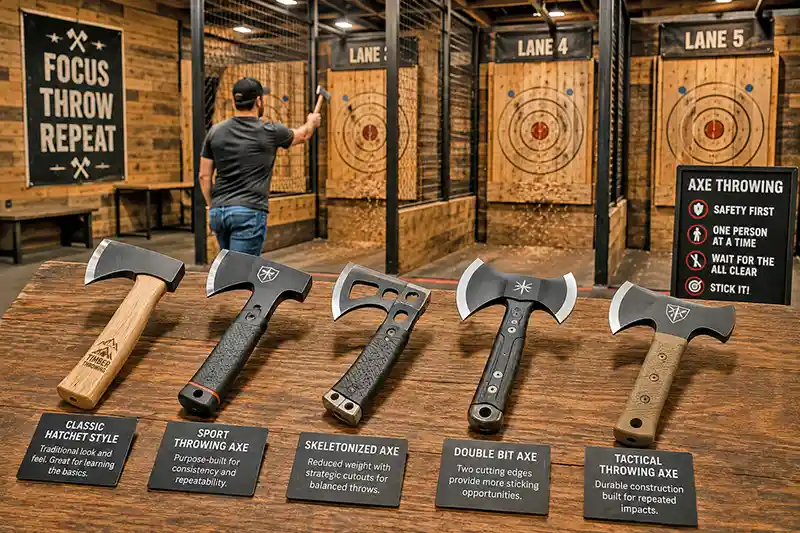
The axes seen at modern throwing ranges are not simply reproductions of historical battlefield weapons. Once axe throwing became a recreational activity and competitive sport, designers had a new problem to solve: create an axe that behaves consistently during hundreds or even thousands of repeated throws at wooden targets. That environment rewards a different set of qualities than warfare ever did.
Consistency becomes especially important. A straight, comfortable handle makes the release easier to reproduce. A manageable overall length makes the axe less cumbersome. A relatively simple head allows the thrower to concentrate on distance and rotation rather than compensate for an unusually shaped weapon. Durability matters too, since repeated impacts with wooden targets, failed sticks, and occasional handle strikes can punish an axe in ways its historical counterpart was never expected to endure repeatedly.
Modern throwing axes can still vary considerably. Some are essentially traditional hatchets used for target throwing, while others are much more obviously designed around the sport. Specialized designs may alter the blade profile, handle construction, or even the number of potential striking edges. What unites them is not one mandatory shape, but an emphasis on repeatable behavior.
This is also why today's recreational axe throwing can give us a distorted impression of what a "throwing axe" should look like. Modern designs evolved within standardized targets, measured distances, rules, and repeated practice. Historical warriors had none of those guarantees. The modern throwing axe is not the final perfected form of an ancient battlefield weapon. It is an axe adapted to an entirely different environment.
A Tomahawk Shows Why the Categories Can Get Messy
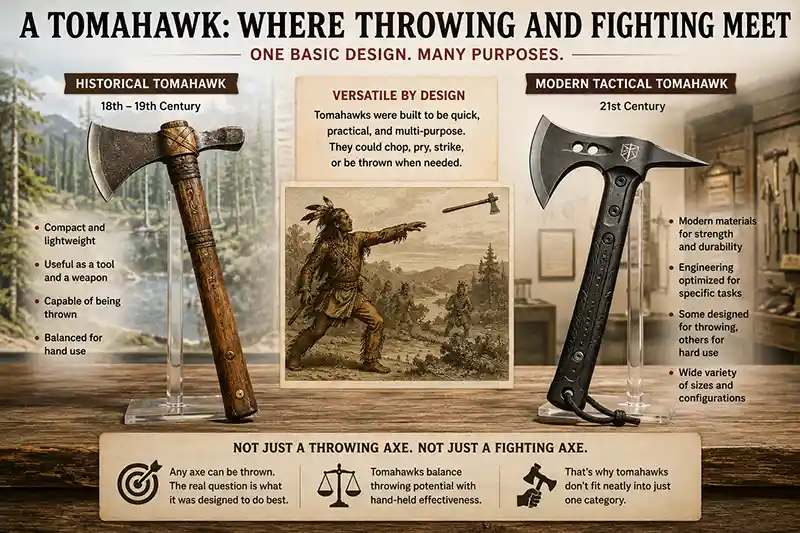
The tomahawk is a useful reminder that "throwing axe" and "fighting axe" are descriptions of use, not always completely separate categories of weapon. Historical tomahawks were compact enough to carry easily and could serve as practical hand tools as well as weapons. Some could also be thrown, but that does not mean every tomahawk was designed primarily around throwing.
Their proportions help explain the versatility. Compared with many larger fighting axes, tomahawks generally have relatively light heads and manageable handles. Those qualities make them quick in the hand while also making throwing practical. At the same time, the handle still provides enough reach and leverage for the axe to function effectively without ever leaving the user's grip.
Modern designs blur the boundary even further. A tactical tomahawk may borrow the compact proportions of historical tomahawks while using completely different materials, construction methods, and head geometry. Some contemporary tomahawks are suitable for recreational throwing, but others prioritize durability, utility, or hand-held use instead. Their appearance alone does not tell us which role mattered most to the designer.
This is why the question "Can this axe be thrown?" is less useful than it first appears. Almost any reasonably manageable axe can be thrown. The more revealing question is what compromises were made to make throwing predictable without sacrificing the other things the axe was expected to do. The tomahawk sits directly in that overlap, which is precisely why it resists being placed neatly into either the throwing-axe or fighting-axe category.
Rotation Is Important, but Throwing Axes Do Not Need Special Aerodynamics
Because a thrown axe spins through the air, it is easy to imagine its unusual proportions as a kind of primitive aerodynamic engineering. In reality, the most important part of its flight is much simpler. The axe needs to rotate predictably enough that an edge is facing the target when it arrives. It does not need to fly point-first like an arrow, nor does its blade need to generate lift like a wing.
The rotation happens because the thrower releases the axe while it already has both forward motion and angular motion. Once it leaves the hand, the axe continues rotating around its center of mass. Changing the distance to the target changes how much time the axe has to rotate before impact, which is why an otherwise consistent throw can arrive blade-first at one distance and handle-first at another.
This also explains why unusual-looking cutouts, spikes, holes, and dramatic blade shapes on modern axes should not automatically be interpreted as aerodynamic features. They may reduce weight, change mass distribution, serve another intended function, or simply contribute to the design's appearance. For the relatively short distances involved in ordinary axe throwing, predictable mass distribution and a repeatable release matter far more than making the axe "slice through the air" like a projectile designed for long-range flight.
That makes axe throwing fundamentally different from throwing a dart or launching an arrow. The axe is not trying to remain pointed toward the target throughout its journey. Its defining characteristic is precisely the opposite: it is expected to rotate, and success depends on making that rotation predictable enough that the correct part of the axe arrives at the correct moment.
Historical Fighting Axes Were Often Lighter Than They Look
Popular culture has helped create an image of the battle axe as an enormous, brutally heavy weapon that required exceptional strength just to swing. Surviving historical examples tell a more interesting story. Many axes intended for combat used surprisingly economical construction, with relatively thin blades that widened toward the cutting edge rather than thick slabs of metal throughout the entire head.
There was a practical reason for this. Excess weight could make an axe slower to redirect and more exhausting to use, while a long handle already provided considerable leverage and striking speed. Smiths could therefore spread a comparatively modest amount of iron or steel into a broad blade without burdening the wielder with unnecessary mass. The dramatic silhouette of an axe can make it look much heavier than it actually is.
This complicates the common assumption that throwing axes are light while fighting axes are heavy. Some fighting axes certainly were heavier than compact throwing hatchets, but weight alone does not define either category. A large-looking historical axe could be relatively nimble, while a small modern axe with thick steel construction might be surprisingly heavy for its size.
The more meaningful difference lies in what designers did with that mass. A fighting axe could distribute its material to favor reach, durability, edge geometry, and performance during a controlled swing. A purpose-built throwing axe has an additional concern: whatever shape and weight it has must behave consistently after it is no longer attached to the thrower's hand. That difference in priorities, rather than a simple division between "heavy" and "light," is what separates the two designs.
Not Every Axe Called a Throwing Axe Was Designed Only to Be Thrown
Historical terminology can make this subject seem much cleaner than it really was. When modern writers describe something as a "throwing axe," the name can imply a specialized weapon whose entire design revolved around leaving the hand. In many historical contexts, however, an axe could be suitable for throwing without being useless in close combat. The distinction often describes a capability rather than an exclusive purpose.
That makes sense on a practical level. Throwing away a weapon during a battle carries an obvious cost: once the axe leaves the hand, the warrior may not get it back. A versatile axe that could be thrown at an opportune moment and still function effectively in the hand offered more options than a weapon useful only as a projectile. The francisca is an important example, but it was hardly the only compact axe capable of crossing that boundary.
The same distinction survives today. Some axes are deliberately optimized for target throwing, while ordinary hatchets and tomahawks can also be thrown successfully. That does not retroactively turn every compact axe into a specialized throwing weapon. Intended purpose, construction, proportions, and historical context all have to be considered together.
This is why comparing different types of throwing weapons can reveal such dramatically different shapes. A weapon does not need to belong to one rigid design family simply because people learned to throw it. In the case of the axe, the most interesting designs are often those that could cross the boundary between projectile and hand-held weapon without being perfectly optimized for either one.
Double-Bit Axes Reveal What Happens When Sticking Becomes the Priority
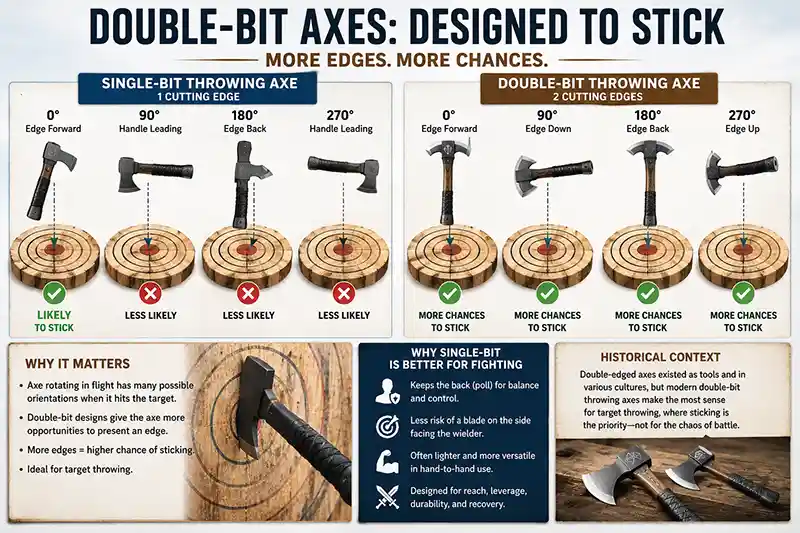
Few designs make the difference between target throwing and battlefield practicality as obvious as the double-bit throwing axe. Put a cutting edge on opposite sides of the head and the axe gains an immediate advantage when thrown at a wooden target: more orientations during its rotation can potentially present an edge capable of sticking.
That advantage becomes much less compelling when the axe is intended primarily for fighting. Adding a second blade can increase the size and mass of the head while eliminating the poll, or back portion, that many single-bit axes could use for balance or other functions. It also puts a cutting edge on the side of the head facing back toward the wielder, a tradeoff that offers little benefit if the weapon's main job is to remain under continuous hand control.
Double-bitted axes certainly existed historically, particularly as tools, and double-edged axe forms appear in several cultures. That does not mean the modern double-bit throwing axe is simply a surviving battlefield design. Its usefulness makes much more sense when viewed through the specialized demands of target throwing, where increasing the chances of an edge arriving in a favorable orientation can be valuable.
This is a perfect example of how intended use can reshape an otherwise ancient idea. Fighting axe designers had to think about reach, recovery, leverage, durability, and how the weapon behaved throughout an encounter. A recreational throwing design can sacrifice some of that versatility in exchange for one very specific advantage: making the rotating axe more forgiving when it reaches the target.
The Target Changed What Counts as a Good Blade
A battlefield axe and a recreational throwing axe are ultimately judged against very different targets. Historical fighting axes had to function against moving opponents, clothing, shields, weapons, and, depending on the period, various forms of armor. Designers could not assume that every strike would arrive at an ideal angle or land against a flat, forgiving surface.
Modern axe throwing removes much of that uncertainty. The target is typically a broad wooden surface made from relatively soft lumber that allows an edge to penetrate and remain embedded. Under those conditions, the blade does not need to solve all of the problems faced by a battlefield weapon. It needs suitable edge geometry and enough exposed cutting edge to stick reliably when the axe arrives at an acceptable angle.
That difference helps explain why features that look advantageous on a fighting axe may provide little benefit on a target thrower. Extreme reach is unnecessary once the weapon has left the hand. A heavily reinforced head may add unwanted mass. A blade profile intended to interact with armor or an opponent's equipment may offer no meaningful advantage against a stationary plank of wood.
In other words, the wooden target did more than give modern axe throwers something safe and repeatable to aim at. It created its own evolutionary pressure on axe design. Once success could be measured by whether the blade consistently embedded itself in a predictable target, designers were free to optimize the axe around that narrow task rather than the much broader demands of survival in close combat.
Fighting Axes Had to Survive a Miss
One of the biggest differences between combat and target throwing appears when everything goes wrong. A modern throwing axe that misses its ideal orientation may strike a wooden target with the handle or another part of the head. That is undesirable, but the throw is simply over. In a fight, a poorly placed strike could leave the weapon in an awkward position while the opponent was still moving and fighting back.
That placed a premium on control and recovery. A fighting axe had to remain manageable after a strike whether the edge connected cleanly, glanced away, was intercepted, or missed altogether. Excessive head weight could become a liability because the wielder had to arrest that momentum and bring the weapon back under control. Reach and striking power mattered, but so did the ability to reposition the axe quickly enough to continue fighting.
The shape of the head could also provide options beyond the cutting edge. Depending on the particular axe, the back of the head might incorporate a hammer-like poll, spike, or other feature, while parts of the head could potentially be used to hook or manipulate an opponent's equipment. These features make more sense on a weapon expected to remain in the hands than on one whose performance is judged primarily by how consistently its edge enters a wooden target.
This may be the most fundamental difference between the two design philosophies. A throwing axe is optimized around what happens after release and at the instant it reaches its target. A fighting axe has to remain useful before, during, and immediately after the strike. Its job does not end at impact.
The Famous Viking Throwing Axe Is More Complicated Than It Sounds
Vikings are so closely associated with axes that the idea of warriors hurling them across the battlefield seems almost inevitable. Modern depictions frequently show Viking fighters throwing axes before drawing another weapon, but the historical evidence is not strong enough to treat routine axe throwing as a defining feature of Viking warfare. Nor was there one standard "Viking throwing axe" comparable to the francisca associated with the Franks.
Axes were certainly common in the Viking Age, and they ranged from relatively compact examples to formidable long-handled weapons. A smaller axe could physically be thrown, and medieval literature contains accounts of axes being hurled in combat. The problem is turning those individual references into evidence that Viking axes were generally designed around throwing. Archaeological axe heads do not conveniently divide into obvious categories labeled for hand fighting and throwing.
This distinction becomes especially important with famous designs such as the broad-bladed Danish axe. Its large cutting edge can look extraordinarily heavy in photographs and reproductions, yet historical examples could use remarkably thin blade construction to control weight. Combined with a long haft, the result was a weapon built to exploit reach, leverage, and cutting power. Those same proportions would make little sense if predictable target throwing had been the primary design objective.
The Viking example reinforces a rule that applies throughout axe history: the ability to throw a weapon does not prove that throwing dictated its shape. Before calling an old axe a throwing axe, we have to look for something more convincing than the fact that a determined person could send it through the air.
Could a Fighting Axe Be Thrown in an Emergency?
Absolutely, provided it was small and manageable enough. Historical warriors did not need an axe to belong to a specialized "throwing" category before they could decide to hurl it. A compact hand axe could become a projectile whenever circumstances made that worthwhile. What matters is that being physically throwable and being optimized for throwing are two very different things.
A fighting axe might rotate less conveniently than a purpose-built target thrower, have a handle that made the release awkward, or carry its mass in a way that required more practice to predict. None of those characteristics would prevent someone from throwing it. They would simply make consistent edge-first impacts harder to reproduce, especially at varying distances.
There was also a much greater consequence to throwing a weapon historically than there is at a modern range. A missed target throw costs a few seconds. A missed battlefield throw could leave the person who threw it without that weapon at precisely the moment an opponent was closing the distance. Unless another weapon was immediately available, throwing away a perfectly useful hand-held axe could be a dangerous gamble.
That helps explain why historical accounts of axes being thrown should be interpreted carefully. They can demonstrate that warriors sometimes threw axes, but they do not automatically reveal why a particular axe was shaped the way it was. To establish that throwing influenced the design itself, we need to look beyond the act of throwing and consider the weapon's proportions, construction, historical context, and the other jobs it was expected to perform.
The Best Throwing Axe Is Not Necessarily the Best Fighting Axe
After comparing handles, blade profiles, weight distribution, historical examples, and modern target designs, a pattern emerges: there is no single axe shape that is simply "better." Every design represents a set of compromises. Improving an axe for one job can make it less convenient for another.
A longer handle can provide a fighter with greater reach and leverage, yet make repeated throwing more cumbersome. Concentrating mass toward the head can produce authoritative hand-held strikes, but changes the way the entire weapon rotates after release. A compact design can be easier to throw consistently, while giving up some of the reach available to a longer fighting weapon. Even adding a second cutting edge can make sense when sticking into a wooden target is the objective while offering far less advantage in a weapon meant to remain in the hand.
This is why the differences between throwing and fighting axes are more subtle than simply making one smaller and lighter. Designers are solving different mechanical problems. The fighting axe remains connected to a person who can control it throughout the strike. The throwing axe eventually has to succeed completely on its own.
That distinction also explains the enormous variety seen across historical and modern axes. The francisca, tomahawk, Danish axe, ordinary hatchet, and modern target thrower are all recognizably axes, yet each reflects a different mixture of priorities. Their shapes make the most sense not when we ask which axe is best, but when we ask what each one was actually expected to do.
Different Axes for Different Problems
Throwing axes and fighting axes began with the same remarkably simple idea: attach a sharpened metal head to a handle. What happened after that depended on the problem the axe was expected to solve. Keep it in the hand and reach, leverage, recovery, versatility, and control become crucial. Let it go and balance, manageable proportions, predictable rotation, and the orientation of the blade at impact suddenly matter much more.
History makes the distinction even more interesting because the boundary was never absolute. The francisca could be thrown yet still belonged to the chaos of early medieval warfare. Tomahawks could cross between tool, hand-held weapon, and throwable axe. Viking Age axes remind us that merely being capable of flight does not prove that a weapon was designed around it. Modern target throwing eventually created something different again, allowing axes to be refined specifically for repeated throws at predictable wooden targets.
Perhaps that is the most revealing thing about the shape of an axe. Features that seem strange or unnecessary often make sense once we stop looking at the weapon in isolation. A long handle, thin broad blade, compact head, unusual curve, or second cutting edge represents a choice about what the axe should do well and what its designer was willing to sacrifice. Throwing axes look different from fighting axes because sending an axe through the air and keeping one under control in your hands may share the same basic tool, but they are fundamentally different mechanical problems.
Do throwing axes need to spin in the air?
Most conventional axe-throwing techniques involve the axe rotating after it leaves the hand. The goal is not to make it spin as quickly as possible, but to produce predictable rotation so that the cutting edge reaches the target at a useful angle. Distance plays an important role because moving farther from or closer to the target changes how much time the axe has to rotate before impact.
How many times should a throwing axe rotate before hitting the target?
There is no universal number of rotations that a throwing axe must complete. Many recreational throwers use distances and techniques that produce roughly one full rotation before the axe reaches the target, but other distances can produce different numbers of rotations. What matters is that the thrower uses a repeatable release and distance so the cutting edge arrives at the target at the correct orientation.
This is also why moving even a relatively small distance forward or backward can change whether an axe sticks. The axe continues rotating throughout its flight, so changing its flight time changes which part of the axe reaches the target first.
Are throwing axes lighter than fighting axes?
Not necessarily. Many modern throwing axes are compact and relatively light because those proportions make repeated target throwing more manageable, but weight alone does not determine whether an axe is suited for throwing or fighting. Some historical fighting axes were surprisingly light despite having large-looking blades, while compact modern axes can be quite heavy because of their thick steel construction.
The distribution of that weight is often more important than the total number on a scale. Handle length, head mass, blade thickness, and the location of the center of mass all affect how an axe handles and rotates. A throwing axe benefits from predictable behavior after release, while a fighting axe can be designed around leverage, reach, control, and recovery in the wielder's hands.
Can you throw a regular hatchet?
Yes. A regular hatchet can often be thrown successfully even if it was not specifically designed for target throwing. Its relatively short handle and compact size can make it manageable in flight, although differences in head weight, handle shape, and balance may make some hatchets considerably easier to throw consistently than others.
This is an important example of the difference between a weapon or tool being throwable and being optimized for throwing. A purpose-built throwing axe is designed with predictable repeated throws in mind, while an ordinary hatchet may have been designed primarily for chopping and general utility. Both can travel through the air, but they were not necessarily designed around the same priorities.
Were throwing axes actually used in battle?
Yes. There is historical evidence for axes being thrown in warfare, with the francisca associated with the early medieval Franks being one of the best-known examples. Period written accounts describe Frankish warriors hurling axes, although the exact techniques and circumstances of their use are harder to reconstruct with certainty.
That does not mean throwing axes were universally common battlefield weapons or that every compact fighting axe was intended to be thrown. Throwing away a useful hand-held weapon carried obvious risks, and many historical axes were designed primarily around close combat. The evidence is strongest when throwing is considered one possible battlefield use rather than something every axe-wielding warrior routinely did.
What is the difference between a throwing axe and a tomahawk?
A throwing axe is defined largely by what it is designed to do, while a tomahawk refers to a particular family of compact axes with a much broader history. Tomahawks developed as versatile hand-held tools and weapons in North America, and many examples can be thrown effectively. Throwing, however, is not what makes an axe a tomahawk.
Modern purpose-built throwing axes are often optimized for predictable rotation and repeated impacts with wooden targets. Tomahawks may instead prioritize portability, chopping ability, durability, hand-held use, or a combination of functions. Some modern tomahawks happen to make excellent throwing implements, which is why the two categories frequently overlap without actually meaning the same thing.
Why do throwing axes have short handles?
Many modern throwing axes have relatively short handles because compact dimensions make them easier to release consistently and more manageable during repeated target throwing. Handle length also influences an axe's mass distribution and rotational behavior, so changing it can affect how the axe turns after leaving the hand.
That does not mean every historical throwing axe had a short handle or that short-handled axes were necessarily intended for throwing. Compact fighting axes and utility hatchets also existed because short handles made them portable and quick to maneuver. As with blade shape and weight, handle length only makes sense when considered alongside the axe's overall design and intended purpose.
Why do some throwing axes have two blades?
A double-bit throwing axe places a cutting edge on both sides of the head, giving the rotating axe more opportunities for an edge to meet the target. That can make the design more forgiving during recreational target throwing because the axe does not have to arrive in exactly the same orientation required by a single-bit axe.
The second blade does not automatically make the axe superior, however. It changes the weight and balance of the head and offers fewer advantages when the axe is intended primarily to remain in the hand. Double-bitted axes have existed historically for other purposes, but the usefulness of two edges on a modern throwing axe is closely tied to the specialized goal of sticking into a wooden target.
How far were throwing axes thrown in battle?
There was no universal battlefield throwing distance, and surviving evidence rarely gives us the precise measurements we would want today. Historical axe throwing was also very different from standing at a marked line and attempting to stick an axe into a stationary wooden target. A warrior had to consider accuracy, the movement of the enemy, the risk of losing the weapon, and what would happen immediately after the throw.
For weapons such as the Frankish francisca, relatively short battlefield distances are more plausible than the dramatic long-range throws sometimes depicted in fiction. The goal may also have included disrupting an enemy formation or forcing opponents to react, rather than achieving the clean blade-first impact expected in modern target throwing.
Is a francisca the same thing as a throwing axe?
The francisca is a historical type of axe strongly associated with the Franks and with being thrown in battle, so describing it as a throwing axe is reasonable. However, it should not be imagined as an early version of the standardized axes used at modern throwing ranges.
Franciscas had distinctive curved profiles and existed within an early medieval battlefield environment. Their design reflected the needs of warriors rather than the requirements of recreational target throwing, making the francisca a particular historical weapon that could be thrown rather than a generic model for all throwing axes.
Were Viking axes designed to be thrown?
Some Viking Age axes were certainly small enough to throw, and medieval accounts include instances of axes being hurled during combat. The evidence does not support treating axe throwing as the defining purpose of Viking axes generally, however. Viking Age axes appeared in numerous sizes and forms, many of which were clearly well suited to hand-held combat.
The famous long-handled Danish axe is an especially poor match for the modern idea of a dedicated throwing axe. Its reach, broad cutting edge, and long haft make much more sense as features of a hand-held fighting weapon. A historical axe being capable of being thrown does not prove that its shape was designed specifically for that purpose.
Does a heavier axe hit harder when thrown?
A heavier axe can carry more momentum at the same speed, but simply adding weight does not automatically create a better throwing axe. The thrower still has to accelerate and release the weapon consistently, while the axe must rotate into a useful orientation before reaching the target.
An excessively heavy head or poorly distributed mass can make an axe more difficult to throw predictably. This is why throwing-axe design involves a compromise between sufficient mass, manageable dimensions, and consistent rotational behavior rather than a simple attempt to make the heaviest projectile possible.
Why are modern throwing axes different from historical throwing axes?
Modern throwing axes can be designed around an environment that historical warriors never encountered: repeated throws from predictable distances at standardized wooden targets. That rewards manageable size, consistent balance, durability, and rotational behavior that a thrower can learn through repetition.
Historical axes had different priorities. Even axes known to have been thrown could exist within a much broader combat system and might still need to function effectively in the hand. The result is that historical weapons such as the francisca can look quite different from today's purpose-built target throwers. Modern throwing axes are not necessarily perfected versions of ancient weapons. They are axes adapted to a different job.
You May Also Be Interested In:
- Modern Throwing Axes and Other Dangerous Weapons!
- Quickly Learn How To Throw Knives, Axes, Spikes, Cards & Stars!
- The Forgotten Combat Knives That Shaped Modern Warfare
- What Is a Fighting Fan and Was It Really Used in Combat?
- Martial Art Spotlight: The Keysi Fighting Method
- Which Throwing Knives are Best?
- Which Throwing Weapon Would You Choose?
- Deadly Throwing Axe and Other Dangerous Weapons!
- Throwing Knives and Other Deadly Weapons
- Why Your Throwing Knives Aren't Sticking (And How to Fix It)
Leave a Reply