




What Is a Kyoketsu-Shoge? The Ninja Weapon That Was Unlike Anything Else
August 7th, 2026
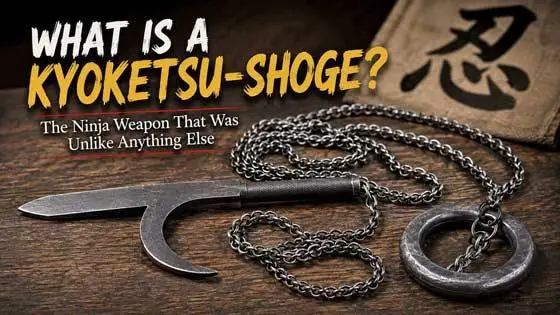
Most people recognize ninja weapons like the katana, throwing stars, and kusarigama, but few have ever heard of the kyoketsu-shoge. At first glance, it looks almost impossible to understand: a double-edged blade attached to a long rope with a heavy metal ring on the opposite end. Yet this unusual design gave its wielder an incredible combination of reach, speed, and versatility that few traditional weapons could match. Whether it was used for climbing, trapping, striking, or keeping opponents at a distance, the kyoketsu-shoge remains one of the most fascinating and mysterious weapons ever associated with Japan's legendary ninja.
What Does "Kyoketsu-Shoge" Mean?
The name "kyoketsu-shoge" roughly translates to "field and mountain tool" or "wildland weapon," although historians still debate its exact meaning. Like many traditional Japanese weapons, its name has evolved over centuries, and written records are surprisingly scarce. That uncertainty has only added to the weapon's mystique.
Unlike a sword or spear, the kyoketsu-shoge combined several tools into a single design. One end featured a straight, double-edged blade for thrusting and slashing. Just below it was a large curved hook that could catch clothing, limbs, branches, or even the edge of a rooftop. Attached to the handle was a long rope or chain that ended in a heavy metal ring, giving the weapon capabilities that were almost impossible to replicate with conventional arms.
Because of this unusual combination, the kyoketsu-shoge could be used at close range, from a distance, or somewhere in between. A skilled user could strike with the blade, hook an opponent's weapon, swing the weighted ring to create space, or retrieve the weapon after a missed attack. It was less like carrying a single weapon and more like carrying an entire toolkit designed for stealth, mobility, and surprise.
Was the Kyoketsu-Shoge Really a Ninja Weapon?
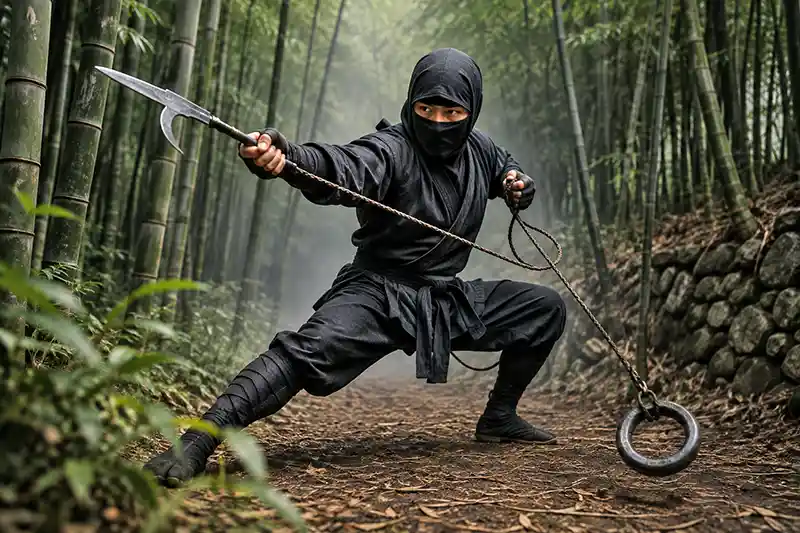
The kyoketsu-shoge is almost always described as a ninja weapon, but the historical evidence is more complicated than movies and video games would have you believe. Unlike the katana or yari, very few surviving documents mention the weapon by name, and there are no famous battlefield accounts describing its widespread use. That has led some historians to question just how common it really was.
Even so, the weapon fits many of the tactics associated with shinobi. A long rope or chain could help retrieve the weapon after throwing it, swing the weighted ring as a distraction, or snag obstacles without getting dangerously close. The hooked blade could catch branches, walls, or an opponent's weapon, making it far more versatile than an ordinary knife. Those features made it especially well suited for stealth, surprise, and mobility rather than standing toe-to-toe in open combat.
Several traditional Japanese martial arts schools, particularly within certain ninjutsu lineages, have preserved techniques involving the kyoketsu-shoge. Whether every historical ninja carried one is doubtful, but there is strong evidence that the weapon was studied and practiced by specialists who valued unconventional tools over conventional battlefield weapons.
Perhaps the biggest reason the kyoketsu-shoge became linked with ninja culture is that it perfectly matches the public's image of what a ninja weapon should be. It is unusual, adaptable, and difficult to master, qualities that continue to fuel its reputation centuries after its origins became clouded by history.
How Was the Kyoketsu-Shoge Actually Used?
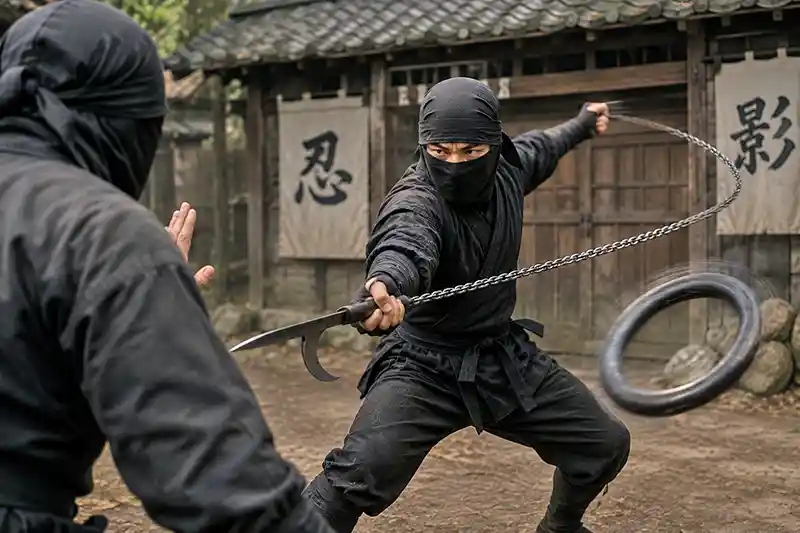
Unlike most weapons, the kyoketsu-shoge wasn't meant to rely on brute force. Its greatest advantage came from keeping an opponent guessing. A skilled user could constantly change the distance between themselves and their target, switching from long-range attacks with the weighted ring to close-range strikes with the blade in a matter of seconds.
The heavy ring was often the first part of the weapon brought into action. It could be swung in wide circles to force an opponent backward, distract them, or disrupt their balance. While the ring drew attention, the hooked blade could suddenly dart forward for a slash, thrust, or hooking maneuver. The rope or chain connecting the two allowed the weapon to flow almost continuously, making it difficult to predict where the next attack would come from.
The curved hook also gave the kyoketsu-shoge abilities that few other weapons possessed. It could snag shields, catch clothing, hook branches, or wrap around an opponent's weapon. Those characteristics make it one of the most unusual examples of Japan's chain weapons, combining reach, entanglement, and cutting power into a single design.
Although mastering the kyoketsu-shoge required years of dedicated practice, its versatility made it a formidable weapon in the hands of an expert. Rather than overpowering an enemy, it rewarded timing, deception, and precision, qualities that have long been associated with Japan's most elusive warriors.
Why the Kyoketsu-Shoge Is Often Compared to the Kusarigama
At a glance, the kyoketsu-shoge and the kusarigama seem closely related. Both combine a hand-held blade with a flexible length of rope or chain, and both depend on timing and distance rather than simple strength. That resemblance is why the two weapons are often mentioned together, but their designs were built around different priorities.
The kusarigama typically pairs a sickle with a weighted chain, giving the user a dedicated cutting tool in one hand and a striking or entangling weight at range. The kyoketsu-shoge replaces the sickle with a straight blade and prominent side hook, while the opposite end usually terminates in a large metal ring. That ring changes the balance of the weapon and gives it a very different feel in motion.
The kyoketsu-shoge also appears to have been designed with mobility in mind. Its hook and ring could potentially serve practical roles beyond combat, including snagging, pulling, or interacting with obstacles. The kusarigama, by contrast, became more closely associated with formalized fighting methods centered on controlling an opponent with the chain before closing in with the sickle.
Those differences are important because they show how inventive Japanese flexible weapons could be. Two tools built around the same basic idea could produce completely different fighting styles simply by changing the shape of the blade and the weight at the opposite end.
Why the Kyoketsu-Shoge Never Became a Common Battlefield Weapon
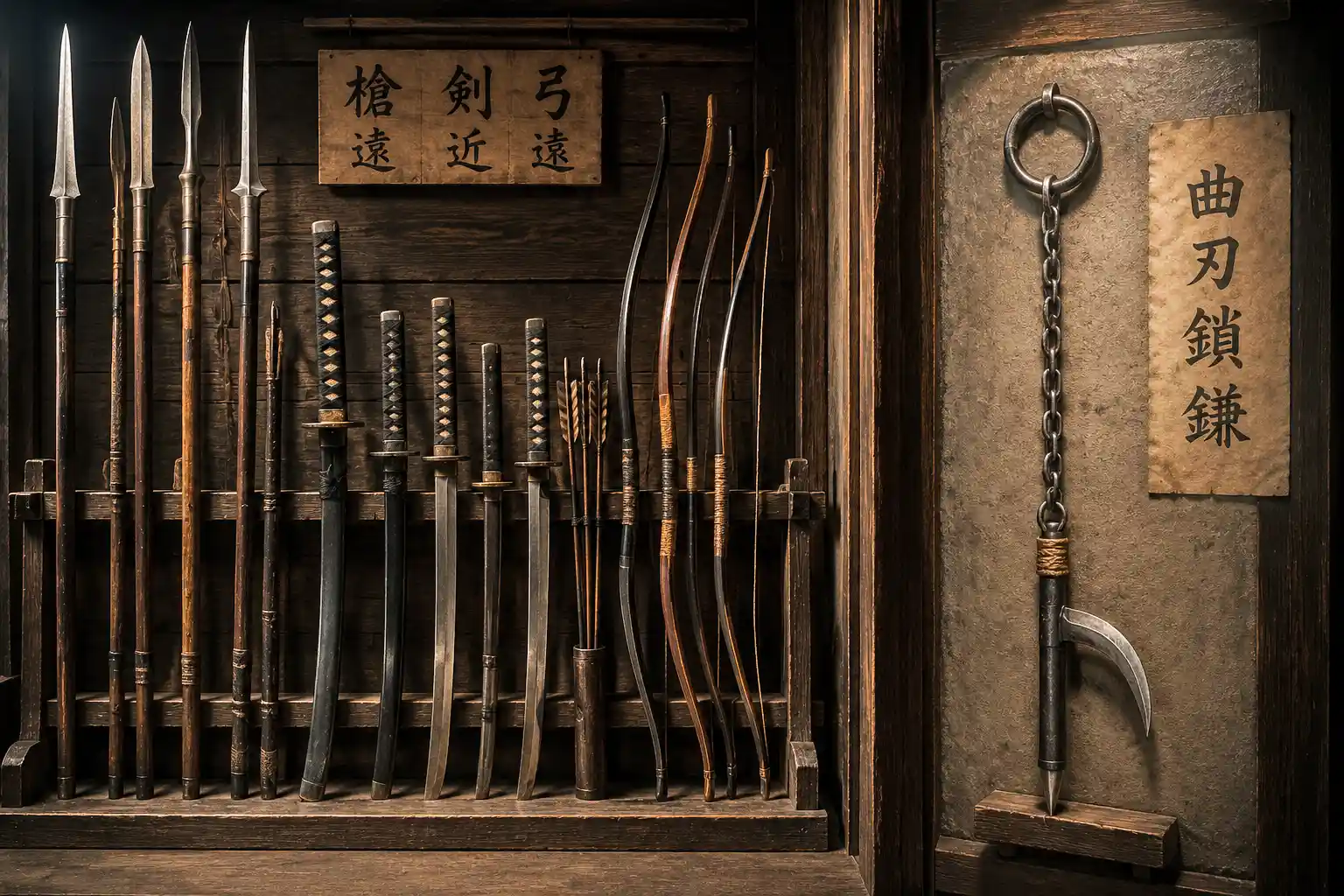
If the kyoketsu-shoge was so versatile, why didn't armies adopt it on a large scale? The answer comes down to practicality. While the weapon offered incredible flexibility, it also demanded an exceptional amount of skill. A poorly timed swing could leave the rope tangled, the ring out of position, or even create an opening for an opponent to exploit.
Traditional battlefield weapons were built around simplicity and reliability. Spears could hold enemies at a distance, swords excelled in close combat, and bows allowed warriors to strike from afar. The kyoketsu-shoge blurred the line between all three roles, but mastering that versatility required years of dedicated practice. Most soldiers simply didn't have the time to become proficient with such a specialized weapon.
That is one reason the kyoketsu-shoge remains far less well known than many other Japanese weapons. Even among collections of famous ninja weapons, it often receives only a brief mention despite being one of the most mechanically fascinating designs ever created. Its rarity has also contributed to the myths surrounding it, many of which are explored in our article on The Truth About Ninja Weapons.
Today, historians and martial arts enthusiasts appreciate the kyoketsu-shoge not because it dominated ancient battlefields, but because it demonstrates just how creative weapon designers could be. It is a reminder that effectiveness is not always measured by how widely a weapon was used, but by how ingeniously it solved specific problems.
Why the Kyoketsu-Shoge Still Captures People's Imagination
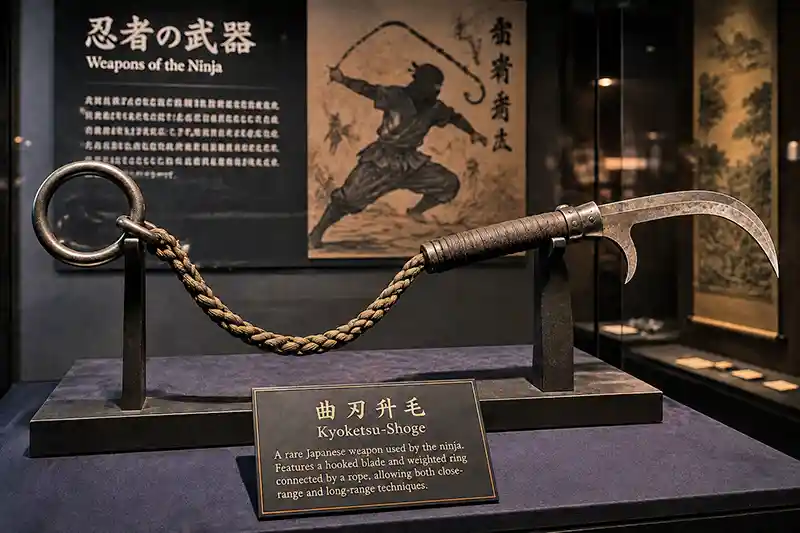
Centuries after it first appeared, the kyoketsu-shoge continues to fascinate martial artists, historians, and movie fans alike. Part of its appeal comes from how different it is. At a time when most weapons were designed to do one thing exceptionally well, the kyoketsu-shoge combined cutting, hooking, striking, entangling, and reach into a single, highly unconventional design.
Its rarity has only made it more intriguing. Unlike famous weapons that appear in museums around the world, authentic examples of the kyoketsu-shoge are difficult to find, and much of what people know comes from martial arts traditions, historical research, and modern recreations. That sense of mystery has helped preserve its reputation as one of Japan's most unusual weapons, earning it a place alongside many of the strangest martial arts weapons ever created.
Today, enthusiasts continue to study the weapon not because they expect to carry one into battle, but because it represents the creativity and adaptability of traditional Japanese weapon design. Whether displayed in a collection, demonstrated in a dojo, or recreated for historical study, the kyoketsu-shoge remains a reminder that some of history's most memorable inventions were also its most unconventional.
If nothing else, the kyoketsu-shoge proves that history is full of surprises. Even among the countless weapons developed across centuries of warfare, few are as distinctive, mysterious, or instantly recognizable once you've seen one.
How the Kyoketsu-Shoge Survived Into the Modern Era
The kyoketsu-shoge never became a mainstream battlefield weapon, but it never completely disappeared either. Its survival is largely thanks to traditional martial arts schools that continued preserving unusual weapons long after they had lost their practical role in warfare. Those schools treated the weapon less as a relic and more as a technical challenge, one that demanded coordination, timing, and precise control over both ends of a flexible weapon.
Modern versions are often built with safer materials for demonstrations and training, while collectors tend to seek reproductions that preserve the weapon's distinctive hooked blade, long cord or chain, and oversized ring. KarateMart's Ninja Shogee is a modern interpretation of this unusual design, making it easier to see why the weapon continues to stand out even among other traditional ninja equipment.
The kyoketsu-shoge has also benefited from the renewed interest in obscure historical weapons. Martial arts enthusiasts are increasingly looking beyond famous swords and throwing stars to study the stranger tools that once existed on the fringes of Japanese warfare. That same curiosity has helped revive interest in other flexible weapons, including the techniques explored in Secrets of the Kusarigama.
What keeps the kyoketsu-shoge relevant today is not practicality, but uniqueness. It represents a kind of weapon design that feels almost experimental, combining multiple functions into one tool and demanding a style of movement completely different from conventional weapons. That alone is enough to ensure it will never be forgotten.
A Weapon Unlike Any Other
The kyoketsu-shoge occupies a unique place in the history of Japanese weapons. It was never as widespread as the katana, as iconic as the shuriken, or as influential as the spear, yet its ingenious design continues to capture the imagination of anyone who encounters it. By combining a blade, hook, rope or chain, and weighted ring into a single tool, it challenged conventional ideas about how a weapon could be used.
Although many details of its history remain uncertain, the kyoketsu-shoge stands as a reminder that innovation often happened far from the battlefield. Specialized weapons were created to solve specialized problems, and few demonstrate that better than this remarkable design. Its blend of versatility, deception, and technical skill has earned it a lasting place among the most fascinating weapons ever associated with Japan.
If learning about the kyoketsu-shoge has sparked your interest, there are plenty of other unusual weapons waiting to be explored. From legendary types of ninja stars to other rare historical designs, the world of traditional Japanese weaponry is filled with ingenious creations that continue to inspire martial artists and history enthusiasts alike.
Whether viewed as a practical tool, a martial arts challenge, or simply a fascinating piece of history, the kyoketsu-shoge proves that some of the world's most memorable weapons are also the most unconventional.
Was the Kyoketsu-Shoge Actually Used by Ninjas?
Yes, but probably not as commonly as popular culture suggests. While the kyoketsu-shoge has long been associated with ninja, surviving historical records are limited, making it difficult to determine how widespread its use really was. However, several traditional ninjutsu schools have preserved techniques for the weapon, suggesting that it was at least studied and practiced by some shinobi. Today, it remains one of the weapons most closely connected to ninja lore because of its unusual design and emphasis on stealth, versatility, and deception.
Could a Kyoketsu-Shoge Be Used for Climbing?
Despite what movies sometimes suggest, the kyoketsu-shoge was not a dedicated climbing tool. Some martial arts traditions describe using its hook or weighted ring to snag branches, ledges, or other obstacles, but there is little historical evidence that ninja routinely used it to scale walls or rooftops. In reality, the weapon was designed primarily for combat and control, with any climbing applications likely being secondary and highly situational. Like many weapons associated with ninja, its real capabilities have often been exaggerated over time.
Was the Kyoketsu-Shoge Harder to Master Than a Sword?
For most people, yes. A sword has a fixed blade, making its movements relatively predictable and easier to control. The kyoketsu-shoge, on the other hand, required the user to manage a blade, a flexible rope or chain, and a heavy metal ring all at the same time. Misjudging the timing or distance could cause the weapon to lose momentum or even become a hazard to its wielder. That complexity is one reason it remained a specialized weapon practiced by experienced martial artists rather than becoming a standard battlefield arm.
How Long Was a Traditional Kyoketsu-Shoge?
There was no single standard size for the kyoketsu-shoge, and its dimensions likely varied depending on the martial arts school or intended purpose. Historical examples generally feature a blade measuring around 8 to 12 inches in length attached to a rope or chain that could extend anywhere from 10 to 15 feet. The large metal ring at the opposite end provided enough weight to swing effectively while also helping the weapon maintain momentum. The long cord gave the wielder the flexibility to fight at multiple distances, making the kyoketsu-shoge one of the most adaptable weapons ever associated with traditional Japanese martial arts.
Why Does the Kyoketsu-Shoge Have a Ring Instead of Another Blade?
The large metal ring is one of the kyoketsu-shoge's most distinctive features, and it serves several purposes that a second blade could not. Its weight allowed it to be swung at an opponent from a distance, creating openings without immediately committing the blade to an attack. It also gave the rope or chain momentum, making it easier to wrap around objects or control the weapon's movement during rapid transitions.
Unlike a sharp blade, the ring could strike, distract, entangle, or even help retrieve the weapon without increasing the risk of cutting the rope or injuring the user. This clever design made the kyoketsu-shoge remarkably versatile, allowing it to shift smoothly between long-range control and close-range combat. The ring wasn't simply a counterweight. It was an essential part of what made the weapon unlike almost anything else in Japanese history.
Are Kyoketsu-Shoge Still Used in Martial Arts Today?
Yes, although they are practiced by a relatively small number of martial artists. The kyoketsu-shoge is considered a specialty weapon, and training with it is generally limited to certain traditional Japanese martial arts schools and modern enthusiasts who study historical weapons. Because it requires exceptional coordination and awareness, beginners typically learn more conventional weapons before attempting a flexible weapon like the kyoketsu-shoge.
Most modern training uses safe practice versions with padded or blunted components, allowing students to develop proper technique without the risks associated with a sharpened blade. Today, the kyoketsu-shoge is valued less as a practical weapon and more as a way to preserve an unusual piece of martial arts history while developing timing, precision, and control.
Could the Kyoketsu-Shoge Be Thrown?
Not in the same way as a spear or throwing knife. While the weighted ring could be swung or cast to distract, entangle, or strike an opponent, the blade remained attached to the rope or chain. This allowed the wielder to pull the weapon back after an attack instead of losing it. The kyoketsu-shoge was designed for continuous movement rather than one decisive throw.
What Made the Kyoketsu-Shoge Different from Ordinary Chain Weapons?
Most chain weapons rely on weighted ends to strike or entangle an opponent. The kyoketsu-shoge added a sharp double-edged blade and a large hook to that formula, allowing it to cut, thrust, snag, trap, and strike with a single weapon. That unusual combination made it one of the most versatile flexible weapons ever developed in Japan.
Why Is the Kyoketsu-Shoge So Rare Today?
Unlike swords and spears, the kyoketsu-shoge was never produced on a large scale. Its specialized design and difficult learning curve meant relatively few martial artists trained with it, and even fewer historical examples survived. Today, most people encounter the weapon through museums, historical research, martial arts demonstrations, or carefully crafted modern reproductions rather than original antiques.
You May Also Be Interested In:
- Ultimate Throwing Weapon Showdown! Which Weapon Is The BEST?
- 5 Deadly Sai Weapon Types
- Which Weapon Would You Choose To Defend Yourself?
- Which Throwing Weapon Would You Choose?
- Was the Seax Really a Viking Weapon?
- Ninja Science
- Deadliest Kung Fu Weapon Challenge
- Practical Self-Defense Weapon: Kubotan
- The History of the Medieval Flail Weapon
- Which Weapon Would You Choose To Survive The Upside Down?
Leave a Reply