



Was the Seax Really a Viking Weapon?
August 24th, 2026
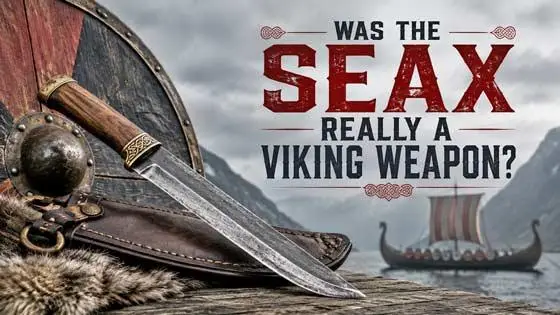
The seax has become so closely associated with the Vikings that it now appears alongside axes, round shields, and longships in countless modern depictions of the Norse world. Archaeology confirms that people in Viking Age Scandinavia really did carry seaxes, including examples large enough to blur the line between knife and short sword. But calling the seax a "Viking weapon" leaves out a much bigger story. These distinctive single-edged blades were already being carried elsewhere in Germanic Europe long before the Viking Age began, and some of the most spectacular surviving examples are not Viking at all. So how did a weapon with such broad origins become one of the blades we associate most strongly with the Vikings?
The Seax Was Already Old Before the Viking Age Began
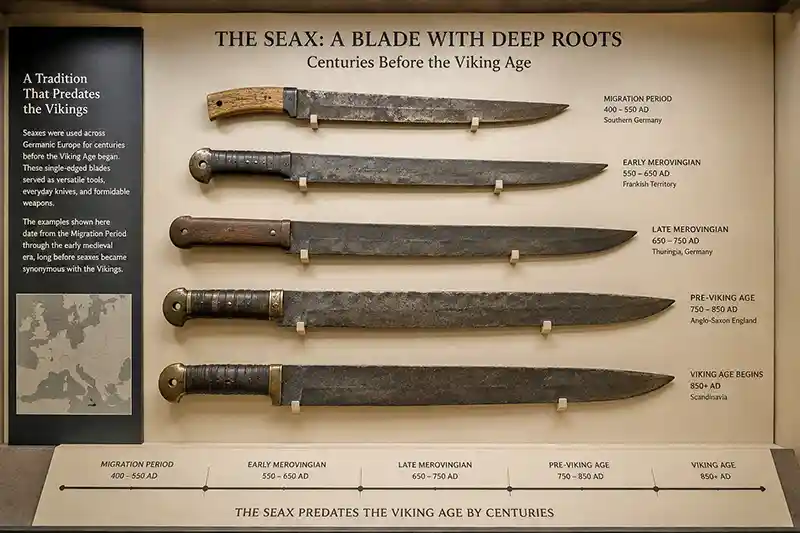
If we want to know whether the seax was really a Viking weapon, the first problem is chronological. The Viking Age is conventionally dated from the late eighth century into the eleventh century, but single-edged blades identified as seaxes appear in European archaeology centuries earlier. By the time Scandinavian raiders began appearing so dramatically in the historical record, the basic weapon was nothing new.
Seaxes were particularly associated with Germanic peoples during the Migration Period and early medieval era. Examples have been recovered from graves and archaeological sites across regions that now include England, Germany, the Netherlands, and parts of continental Europe. They varied enormously. Some were essentially substantial utility knives, while others developed into formidable long blades that could approach short-sword proportions.
The connection runs so deep that the name of the Saxons has traditionally been linked with the word for this type of knife, although the precise linguistic and historical relationship deserves more caution than the familiar story that the Saxons were simply "the people of the seax." What archaeology makes much clearer is that seaxes belonged to a broad Germanic blade tradition rather than appearing suddenly with the Vikings.
That distinction matters. Vikings absolutely existed in a world where seaxes were carried, and Scandinavian examples make them part of Viking Age material culture. But the Vikings inherited an already ancient family of weapons. Calling the seax exclusively Viking would be a little like calling the spear a Viking invention simply because Vikings also carried spears.
So Yes, Vikings Really Did Carry Seaxes
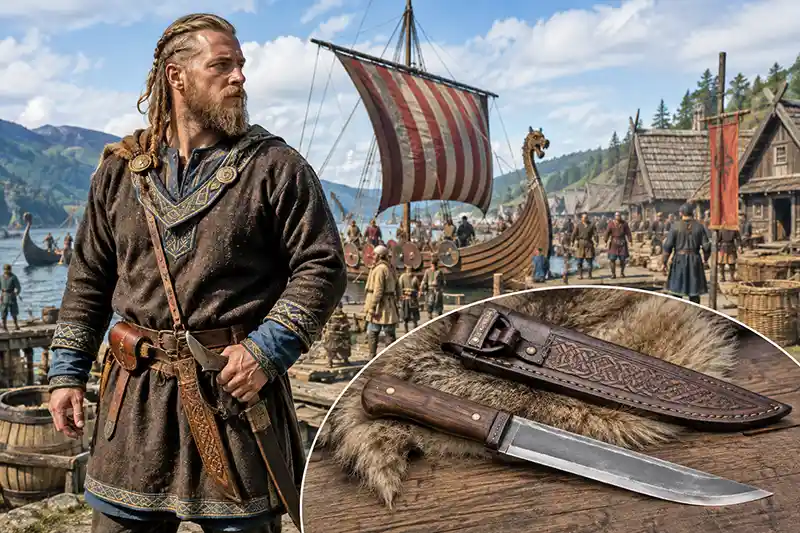
The fact that Vikings did not invent the seax does not make its Viking connection a modern myth. Archaeological finds from Viking Age Scandinavia show that single-edged knives and larger seax-like blades were genuinely part of Norse material culture. The important correction is not that Vikings never used them. It is that they were participating in a much older and broader blade tradition.
For a Viking Age Scandinavian, the line between "knife" and "weapon" was not always as clean as modern categories suggest. Small utility knives were practical everyday objects, while larger single-edged blades could become substantial enough to serve a very different role. Some seaxes grew dramatically in length, producing weapons that modern observers might be tempted to classify somewhere between an oversized knife and a short sword.
That range is one reason modern recreations can look so different from one another. A compact seax-inspired fixed blade knife and a long fighting seax may share recognizable design ancestry while differing enormously in size and intended use. Historically, "seax" describes a family of single-edged blades rather than one weapon built to an exact specification.
So if someone describes a seax as a Viking weapon, they are not necessarily wrong. Vikings really did use blades belonging to this tradition. The mistake comes when that statement quietly turns into "the seax was a weapon invented by and unique to the Vikings." Archaeology tells a much more interesting story.
The Seax Was Never Just One Kind of Blade
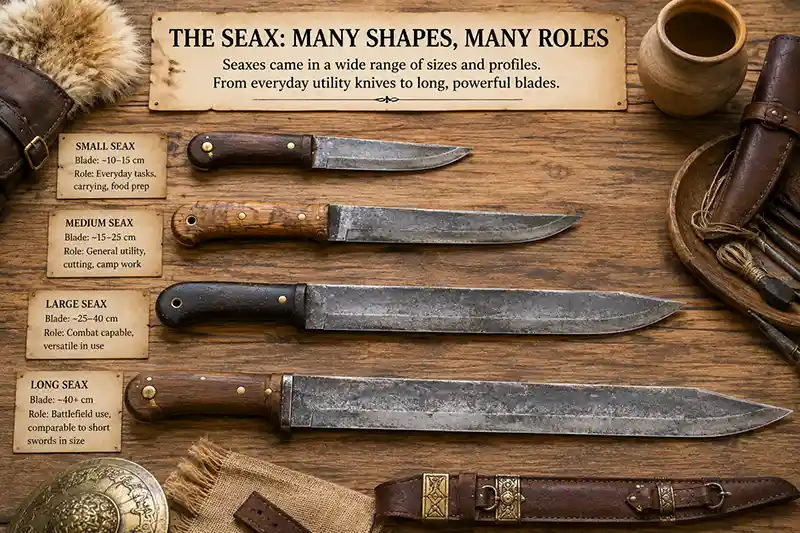
One reason the seax is so easy to misunderstand is that the name encourages us to picture a single standardized weapon. Archaeological finds tell a very different story. Seaxes ranged from relatively small knives to massive long-bladed examples, with considerable variation in width, point shape, construction, and proportions.
Some were practical enough to occupy the territory we would now associate with an everyday knife. Others were clearly substantial objects. The long seax could possess a blade measuring several dozen centimeters, making it difficult to dismiss as nothing more than a utility tool. These larger examples begin to resemble short swords in scale even though their single-edged construction and blade geometry place them within the broader seax tradition.
The shapes changed over time as well. Some seaxes had gently tapering profiles, while others developed the angular point that modern collectors often call a "broken-back" seax. That famous profile is now so strongly associated with the weapon that it can create the false impression that every historical seax looked like one. Our deeper look at why seax knives had such strange blades explores how dramatically these profiles could differ.
This variety matters to the Viking question because saying "Vikings carried seaxes" tells us surprisingly little about what an individual person might have carried. A small working blade and a formidable long seax could belong to the same broad family while filling very different roles. There was no universal Viking seax issued in one familiar shape.
Most Seaxes Were Probably More Than Battlefield Weapons
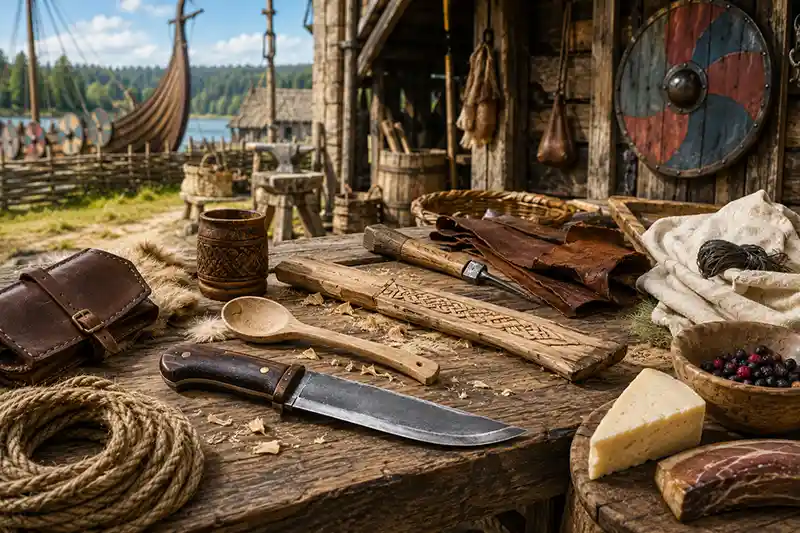
Modern depictions tend to emphasize the seax as a fighting weapon, but that can distort how blades actually fit into early medieval life. A knife was one of the most broadly useful objects a person could carry. Cutting cord, preparing food, working wood, processing hides, and countless other ordinary tasks all required a dependable edge.
This becomes especially important when discussing smaller seaxes. Finding a blade in the grave of an armed individual does not automatically prove that its primary purpose was combat. Some seaxes were certainly large enough to function as formidable weapons, but smaller examples occupied a much murkier territory between personal knife, working tool, status object, and potential weapon.
That ambiguity would not have seemed particularly strange at the time. Modern shoppers are accustomed to dividing knives into highly specific categories, but an early medieval blade could serve several roles over the course of a single day. An object useful around a farmstead or campsite did not suddenly become useless if its owner needed to defend himself.
The larger seaxes complicate the picture in the opposite direction. Once a blade becomes long, heavy, and deliberately constructed at a scale approaching a short sword, describing it as merely an everyday utility knife becomes increasingly unconvincing. The seax tradition appears to have stretched across both worlds, from mundane cutting tool to serious weapon.
That may be one reason the seax endured for so long. It was not locked into a single role. Depending on its size and construction, the same basic family of blades could accompany ordinary daily life or become something considerably more formidable.
The Anglo-Saxons May Have an Even Stronger Claim to the Seax
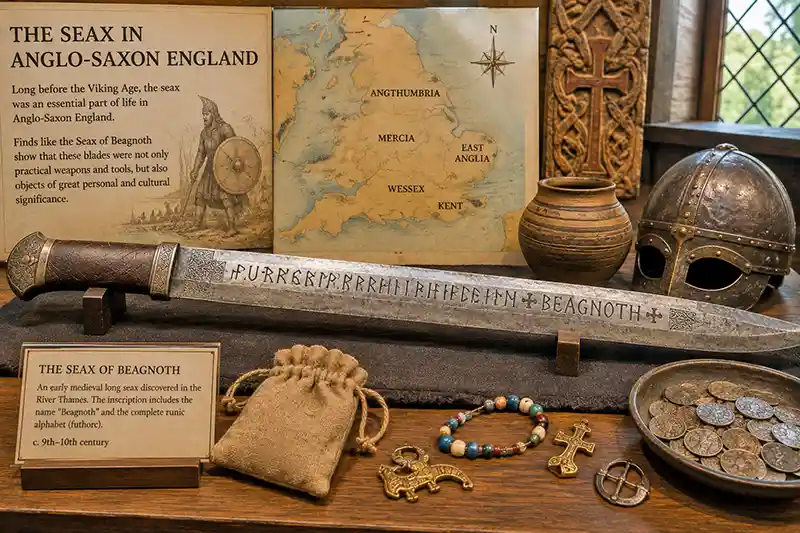
If any culture deserves to complicate the modern idea of the "Viking seax," it is the Anglo-Saxons. Seaxes appear prominently in Anglo-Saxon archaeology, including examples from centuries before Scandinavian Viking activity transformed England. Some of the most famous surviving seaxes are Anglo-Saxon rather than Scandinavian.
The extraordinary Seax of Beagnoth, found in the River Thames and generally dated to the ninth or tenth century, is perhaps the best-known example. Its long iron blade carries elaborate decoration and an inscription containing the complete Anglo-Saxon runic alphabet, or futhorc, along with the name Beagnoth. Few surviving seaxes demonstrate more clearly that these blades had a rich identity outside Scandinavia.
The Anglo-Saxon connection also exposes a problem with the way we label early medieval unusual weapons today. Once an object becomes strongly associated with Vikings in popular culture, the Viking label can overshadow neighboring cultures that used related equipment. A dramatic single-edged blade displayed without context is now easily imagined hanging from a Viking belt even when its closest archaeological parallels may come from England or continental Europe.
This does not turn the argument around and make the seax exclusively Anglo-Saxon either. That would repeat the same mistake. The more accurate picture is a broad Germanic blade tradition shared and adapted across different societies. Vikings belong in that story, but they do not own it.
The Vikings Used the Seax Alongside More Famous Weapons
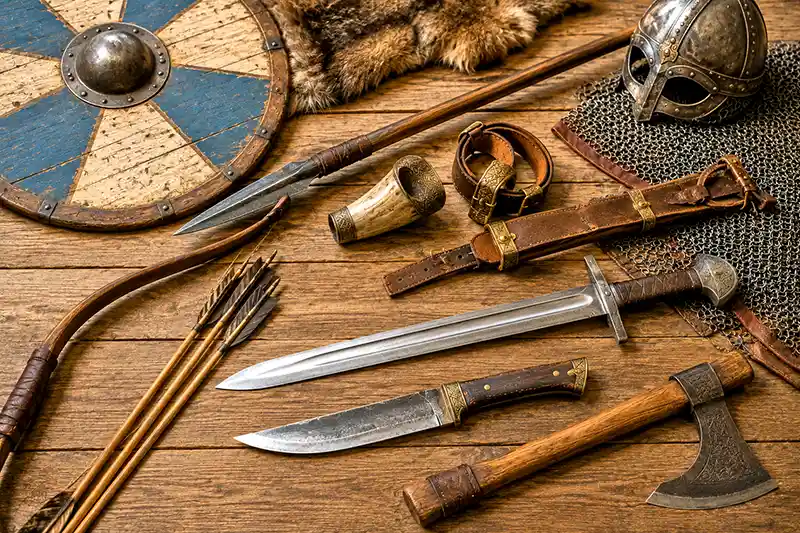
The seax did not exist in isolation within the Viking world. A well-equipped Norse warrior might have had access to spears, axes, shields, bows, and, for those wealthy enough to own them, swords. Against that collection of iconic equipment, the comparatively simple single-edged seax can seem almost ordinary.
That may actually help explain its place in Viking Age society. Swords were expensive prestige objects requiring considerable skill and material to manufacture. A seax could be constructed more simply, and the smaller varieties also had practical uses beyond combat. Carrying one did not necessarily require its owner to possess the resources associated with an elaborate double-edged sword.
Larger seaxes occupied a more interesting middle ground. They could provide considerably more blade than an everyday knife without becoming identical to the classic Viking sword. Modern pieces such as the Modern Viking Seax Sword exaggerate that sword-sized interpretation, but they reflect a real historical truth: some seaxes became impressively large weapons.
This is why asking whether the seax was "the Viking knife" can be misleading. There was no single blade carried by every Viking, and Viking Age Scandinavians had access to a diverse collection of arms and everyday cutting tools. The seax was one member of that larger ecosystem, sometimes modest and practical, sometimes substantial enough to stand beside far more celebrated weapons.
Seaxes Were Carried Differently From Viking Swords
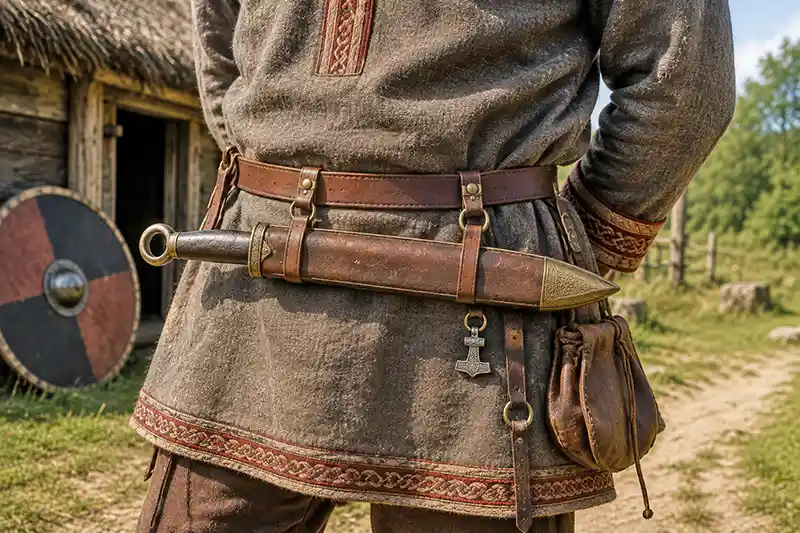
The way a weapon was worn can tell us almost as much as the blade itself. Viking Age swords were typically suspended from belts using scabbards designed to hang along the side of the body. Seax sheaths could be arranged differently, and archaeological evidence suggests that some were worn horizontally or at an angle across the front of the waist rather than hanging like miniature swords.
Surviving sheath fittings and archaeological finds reveal that seax scabbards could be surprisingly elaborate. Leather sheaths might incorporate metal fittings, decorative elements, and suspension points that allowed the blade to sit securely against the body. The edge was generally oriented upward in many reconstructions, although we should be cautious about pretending that every seax across centuries and regions was carried in precisely the same fashion.
This method of carrying also makes sense when we remember how broad the seax family was. A smaller blade worn close to the waist could remain accessible while its owner worked, traveled, or went about daily life. A much larger long seax required a more substantial sheath and suspension arrangement. Modern pieces such as the Ringed Seax Knife preserve the recognizable combination of a single-edged blade and fitted sheath, even though contemporary designs should not be mistaken for archaeological reproductions.
The distinction helps separate the seax from the image of a Viking sword in miniature. It had its own blade shapes, its own range of sizes, and its own traditions of carry. Once those details are considered together, the seax starts looking less like a secondary version of another weapon and more like a distinct class of early medieval blade.
The Long Seax Could Rival a Short Sword
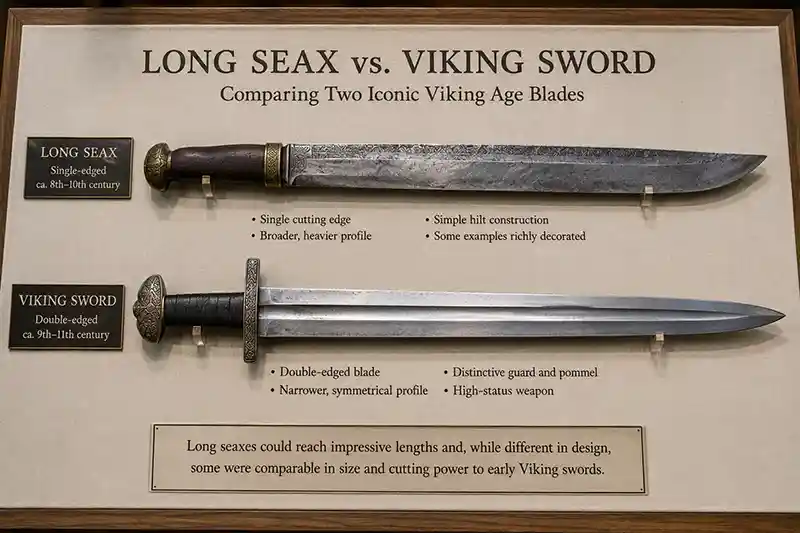
At the upper end of the seax family, the distinction between knife and sword becomes surprisingly difficult to maintain. Long seaxes could have blades extending well beyond the dimensions we normally associate with a belt knife. Some surviving examples are substantial enough that calling them simple utility tools does not adequately describe what they were capable of being.
Yet these weapons did not simply become conventional Viking swords as they grew longer. The classic Viking sword was double-edged and built around a very different blade profile, usually with a prominent guard and distinctive pommel. A long seax retained the single cutting edge and comparatively straightforward hilt construction associated with the broader seax tradition.
That simplicity could produce an intimidating weapon. A long, broad blade concentrates considerable material behind one cutting edge without requiring the symmetrical construction of a double-edged sword. Some examples also display sophisticated craftsmanship, including pattern-welded components, decorative inlays, inscriptions, and other details that undermine the idea that the seax was merely a cheap substitute for a "real" sword.
The long seax is therefore one of the best examples of why modern categories can become awkward when applied to early medieval weapons. A blade might look like an enormous knife to us while occupying a far more serious role in the society that produced it.
By the time a seax reached these proportions, its connection to combat becomes much harder to ignore. Vikings may have carried plenty of smaller blades for ordinary tasks, but the largest members of the seax family demonstrate that this ancient design could also become a dedicated fighting weapon.
Not Every Viking Would Have Carried a Seax
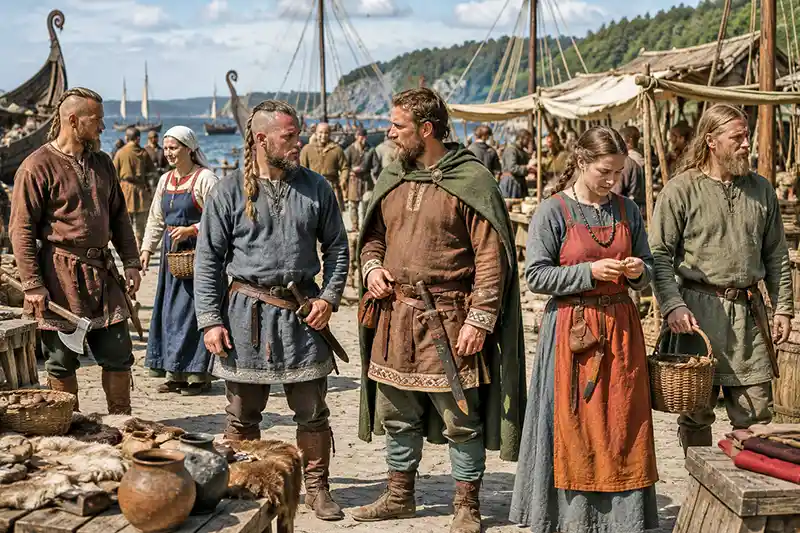
Popular images of the Viking Age often turn historical equipment into something resembling a uniform. Give a figure a round shield, an axe, a sword, and a seax, and the silhouette immediately reads as "Viking." Real Viking Age society was far less standardized. People carried different equipment depending on wealth, occupation, region, social status, and circumstance.
This matters because archaeological evidence for seaxes does not mean that every Scandinavian man walked around with a large fighting seax strapped to his belt. Small knives were commonplace and enormously practical, but substantial weapon-sized seaxes were a different matter. Their distribution also varied geographically and chronologically, just as other forms of early medieval equipment did.
The same caution applies to Viking swords. Swords loom so large in modern portrayals that it is easy to imagine them as standard equipment, yet owning a finely made sword represented a significant investment. Spears and axes could be far more accessible. The weapons found in richly furnished graves therefore cannot simply be treated as an inventory of what every ordinary person owned.
This is where the phrase "Viking weapon" becomes especially slippery. Something can be authentically associated with Viking Age Scandinavia without being universally carried by Vikings. The seax belongs among the remarkable weapons from history, but its presence depended on time, place, size, and the person carrying it.
The historically accurate picture is therefore less uniform and more interesting. There was no standard Viking loadout. The seax was one option within a diverse world of knives, tools, and weapons, and some Vikings undoubtedly carried impressive examples while many others did not.
The Broken-Back Seax Was Not the Only Seax Vikings Knew
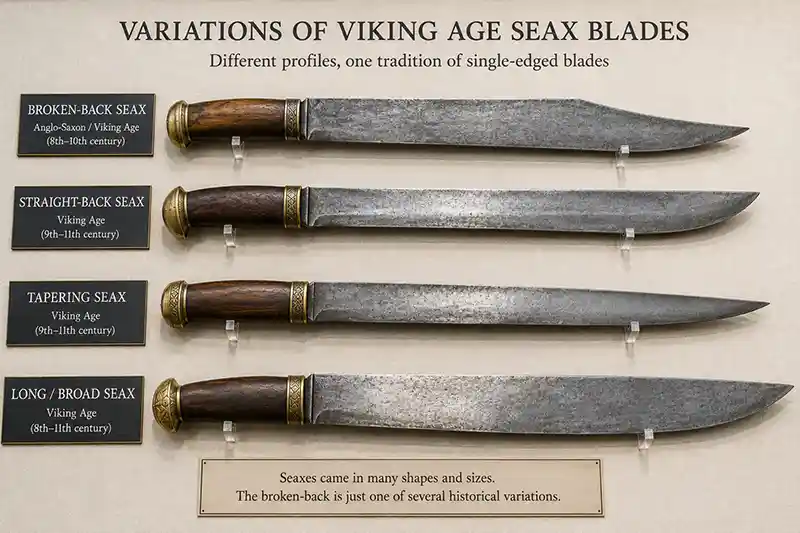
Ask someone to draw a seax today and there is a good chance they will give it an abrupt angular drop along the spine near the point. This distinctive profile is commonly called the broken-back seax, and it has become one of the most recognizable versions of the blade. The problem is that its modern popularity can make it seem like the standard Viking seax.
Historical seaxes were far more diverse. Some had relatively straight backs, others tapered gradually toward the point, and still others had broad blades with profiles that look surprisingly different from the sharp geometric silhouette reproduced so often today. These variations also changed over time and from one region to another.
The broken-back form is particularly famous because of important Anglo-Saxon finds, including the Seax of Beagnoth. That creates an amusing historical reversal: one of the blade shapes modern audiences most readily identify as "Viking" is strongly represented by archaeological material from Anglo-Saxon England.
Modern makers understandably gravitate toward the broken-back profile because it is visually unmistakable. Put one beside an ordinary early medieval knife and the seax immediately looks unusual. That distinctive silhouette has helped transform one historical variation into the popular image of the entire weapon family.
Recognizing the other forms gives us a much more accurate picture. The seax was not defined by one dramatic point shape. What connected these blades was the broader tradition of substantial single-edged knives and weapons that evolved across Germanic Europe over centuries.
The Seax Could Be a Status Symbol as Well as a Weapon
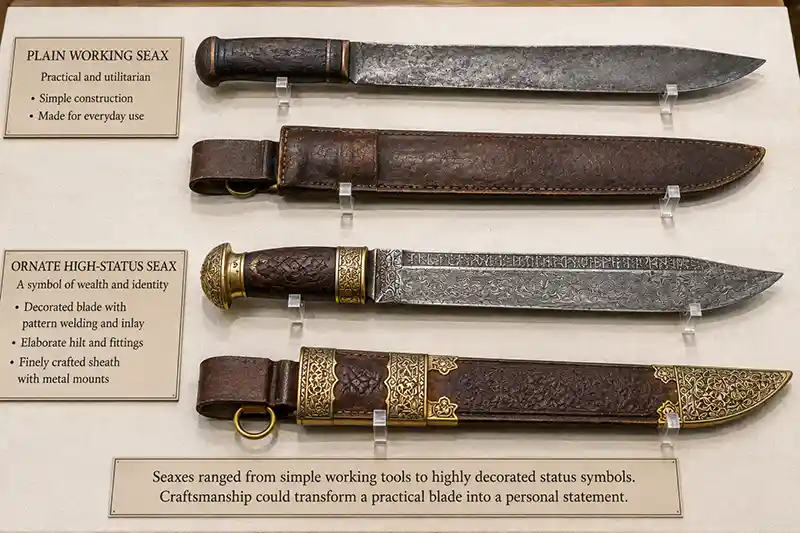
A seax did not have to be enormous to say something about the person carrying it. Archaeologists have uncovered examples with decorated blades, elaborate sheaths, metal fittings, pattern welding, and other forms of craftsmanship that required far more effort than was necessary to produce a basic working knife. These were objects people could invest in, personalize, and display.
The Seax of Beagnoth provides an extreme example. Its blade carries an extraordinary runic inscription, transforming an already substantial weapon into something unmistakably distinctive. Other surviving seaxes and their fittings show that early medieval craftspeople were willing to devote considerable skill to objects that modern observers might otherwise dismiss as oversized utility knives.
This makes sense in a culture where the objects worn on the body were highly visible expressions of wealth and identity. A finely made blade suspended from an elaborate sheath could communicate something about its owner's resources even when it was not being used. The same principle applied to decorated swords, jewelry, belt fittings, and other possessions.
It also complicates attempts to divide every archaeological seax neatly into either "tool" or "weapon." A blade could potentially be practical, dangerous, and prestigious at the same time. Those categories are useful to us, but the person who originally owned the object may not have seen any reason to choose only one.
That helps explain why the seax deserves more attention than its simple construction initially suggests. Beneath the basic formula of a handle and single-edged blade was enormous room for individual craftsmanship, from plain working fixed blades to objects impressive enough to accompany their owners into richly furnished graves.
Why Did the Seax Eventually Disappear?
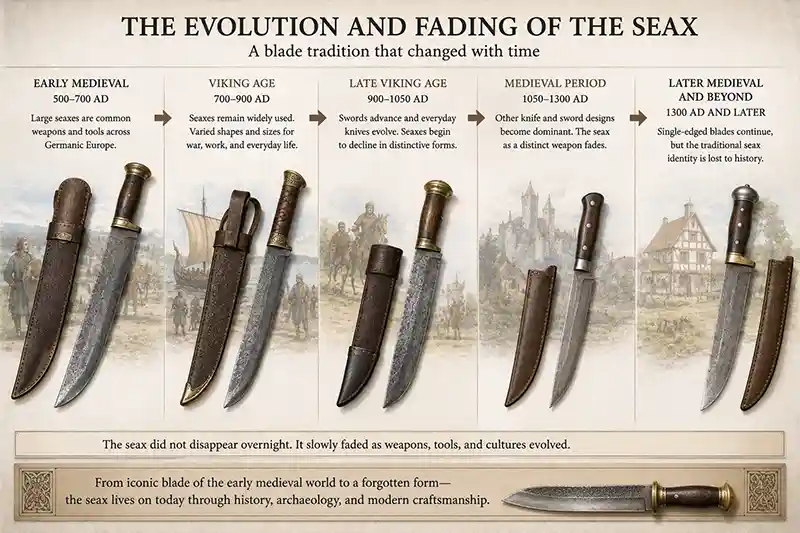
For a blade tradition that survived for centuries across such a large part of Europe, the seax eventually faded with surprisingly little drama. There was no single moment when people suddenly abandoned it. Instead, the distinctive early medieval forms gradually became less common as weapons, tools, clothing, and methods of carrying equipment changed.
By the later Viking Age and into the medieval period, European sword designs were evolving, while everyday knives continued developing along other paths. The social world that had produced enormous long seaxes and elaborate belt-mounted examples was changing as well. Over time, there was less reason for the seax to remain a clearly recognizable category of its own.
That does not mean single-edged blades disappeared. Far from it. Large knives, utility blades, chopping tools, and single-edged weapons continued to appear throughout European history. What faded was the particular combination of shapes, construction traditions, and cultural associations that archaeologists now group under the name seax.
Ironically, modern fascination with the Vikings has helped bring the shape back. Historical reproductions and modern interpretations have transformed an archaeological blade family into something recognizable again, including designs that deliberately exaggerate the angular broken-back profile. The seax has effectively gained a second life among collectors and enthusiasts of historical weapon designs.
Its disappearance also helps explain why the seax feels mysterious today. Unlike the sword or ordinary knife, it did not continue uninterrupted into a familiar modern form carrying the same name. It belonged strongly enough to the early medieval world that when that world changed, the seax as a distinct identity largely went with it.
So Was the Seax Really a Viking Weapon?
Yes, but only if we are careful about what that means. Seaxes were genuinely used in Viking Age Scandinavia, and some examples were substantial enough to function as serious weapons. Calling the seax a Viking weapon is therefore historically defensible. Calling it an exclusively Viking weapon is not.
The blade's story stretches back centuries before the Viking Age and reaches across much of Germanic Europe. Anglo-Saxons, Franks, and other Germanic peoples carried related single-edged blades, while archaeological finds reveal an enormous range of sizes, shapes, and levels of craftsmanship. The Vikings inherited and continued that tradition rather than creating it from scratch.
Popular culture has essentially taken one chapter of the seax's history and allowed it to represent the entire book. Viking imagery gave the weapon a recognizable modern identity, while dramatic broken-back blades and oversized modern interpretations made that association even stronger. The result is a weapon that can now look unmistakably "Viking" even when some of its closest historical relatives came from somewhere else entirely.
And perhaps that is what makes the seax more interesting than the myth. It was not a specialized Viking invention that appeared with the first longships and vanished with the last raiders. It was an ancient, adaptable blade tradition that crossed cultures, changed forms, served everything from ordinary daily tasks to combat, and happened to survive right through one of the most famous periods in European history.
The Vikings really did carry seaxes. They just weren't the first people to do it.
What Is the Difference Between a Seax and a Viking Sword?
The most obvious difference is the blade. A typical Viking Age sword was double-edged, relatively long, and built with a recognizable guard and pommel. A seax was fundamentally a single-edged blade, often with a simpler hilt and a much wider range of possible sizes.
That size variation is important because some seaxes were considerably closer to knives than swords. Others grew into long, broad weapons that could approach short-sword dimensions. Even these large examples retained the basic single-edged construction that distinguished them from conventional Viking swords.
There was also a difference in status. A finely made sword could be an expensive and prestigious possession, while the seax family included everything from relatively ordinary working blades to elaborate weapons decorated with pattern welding, metal fittings, and inscriptions. A seax could certainly be valuable, but owning one did not automatically imply the same thing as owning a high-status sword.
So while a long seax and Viking sword could sometimes overlap in size and purpose, they remained distinct blade traditions. One did not simply represent a cheaper or shorter version of the other.
Did Vikings Use Seaxes in Battle?
Yes, at least some seaxes were clearly capable of serving as battlefield weapons. The strongest candidates are the larger examples, particularly long seaxes whose dimensions move well beyond what we would normally expect from an everyday utility knife. A substantial single-edged blade of that size would have been entirely viable as a weapon.
The harder question is how commonly Vikings deliberately chose a seax as their primary battlefield arm. Archaeology can show us that the blades existed, but it rarely tells us exactly how an individual used a particular weapon during a fight. Spears, axes, and swords are much more prominent in the evidence and historical imagery surrounding Viking warfare.
Smaller seaxes create even more ambiguity. A practical knife carried every day could still become a weapon when necessary without having been designed primarily for battle. Trying to label every excavated seax as either a "combat weapon" or "utility knife" imposes a modern distinction that may not reflect how its owner thought about it.
The safest conclusion is that seaxes absolutely belonged within the Viking Age arsenal, and the largest forms were serious weapons. What we should avoid is imagining every Viking warrior charging into battle with a giant seax as though it were standard military equipment.
Did Vikings Invent the Seax?
No. This is one of the biggest misconceptions created by the seax's modern association with Viking culture. Single-edged blades recognizable as seaxes existed among Germanic peoples centuries before the conventional beginning of the Viking Age in the late eighth century.
Archaeological finds show seaxes appearing across continental Europe and Anglo-Saxon England during earlier periods. Their shapes changed considerably over time, which is exactly what we would expect from a blade tradition that developed across different regions rather than from a weapon invented by one culture at one particular moment.
Viking Age Scandinavians adopted, produced, and carried their own versions within this already established tradition. In that sense, the relationship is similar to many other weapons associated with the Vikings. Norse warriors used spears, swords, bows, and axes without having invented the basic concepts behind those weapons either.
The more interesting question is therefore not who invented the seax, because there probably was no single inventor. It is how an old Germanic family of blades continued evolving until it became part of Viking Age Scandinavian culture and, centuries later, became so closely associated with Vikings that its much older history was almost forgotten.
What Does the Word Seax Actually Mean?
The word "seax," also spelled "sax," comes from old Germanic vocabulary referring to a knife or single-edged cutting blade. Related forms of the word appear in several early Germanic languages, which fits remarkably well with the broad geographic distribution of the blades themselves.
The most famous linguistic connection is with the Saxons. Their name has traditionally been interpreted as meaning something like "people of the seax" or "swordsmen," suggesting such blades were important enough to become associated with an entire people. It is an irresistible story, but the exact etymological relationship is not certain enough to present that explanation as established fact.
What is clearer is that "seax" was not originally a Viking-specific term. Its linguistic roots belong to the wider Germanic world, just as archaeological seaxes appear well beyond Scandinavia. Even the name of the weapon therefore points toward a history considerably broader than the Vikings.
Today, historians, archaeologists, collectors, and modern weapon makers use "seax" as a convenient label for a diverse family of early medieval single-edged blades. That modern category helps us discuss them, but it should not give the impression that every person who carried one 1,200 years ago would have classified these enormously varied blades exactly as we do today.
Were Seaxes Only Used by Men?
No. Archaeological evidence makes it difficult to support such a simple rule. Knives were basic objects of early medieval life, and single-edged blades appear in burial contexts associated with both men and women. Smaller blades in particular should not automatically be interpreted as male warrior equipment simply because modern culture strongly associates the seax with Viking combat.
The larger and more obviously weapon-sized seaxes present a more complicated picture. Early medieval burial customs varied enormously by region and period, and weapons were more commonly associated with male graves in many contexts. Even then, grave goods do not provide a perfect inventory of what every living person was permitted to own, carry, or use.
Size matters here as well. Calling every single-edged knife a "weapon" can distort the archaeological evidence. A modest blade might have been an everyday tool, personal possession, symbolic grave good, or some combination of those things. The enormous long seaxes discussed elsewhere in this article belong to a rather different category.
So the familiar image of a male Viking warrior with a seax represents only one part of a much broader story. These blades existed within everyday early medieval society as well as within its martial culture.
How Do You Pronounce Seax?
In modern English, "seax" is usually pronounced "saks," rhyming with "axe." You may also encounter the spelling "sax," particularly when reading about early Germanic and Anglo-Saxon blades.
The unusual spelling can make the word look as though it should contain two separate vowel sounds, but the "ea" should not be pronounced like the vowel in "sea." The word comes to modern readers through early Germanic languages, so applying ordinary modern English spelling rules to it can be misleading.
You may hear variations when people attempt reconstructed historical pronunciations or discuss related words in Old English and other Germanic languages. For an English-language conversation about the weapon, however, "saks" is a clear and widely understood pronunciation.
Why Is the Seax Sometimes Spelled Sax?
"Seax" and "sax" are closely related spellings rather than names for completely different weapons. The variation comes from the different Germanic languages, historical spellings, and modern conventions used when discussing these early medieval single-edged blades.
"Seax" is particularly familiar from Old English and is the spelling commonly encountered in discussions of Anglo-Saxon examples. Forms resembling "sax" appear elsewhere in Germanic linguistic traditions and are also widely used by modern historians, collectors, and weapon enthusiasts.
This can create unnecessary confusion because modern readers sometimes assume that a seax and a sax must represent different blade shapes. The terminology is much less tidy than that. Historical examples already varied enormously in size and profile, and changing the spelling does not automatically identify a particular type of blade.
When researching the weapon, it is therefore useful to search for both spellings. You may encounter "seax," "sax," and more specific classifications depending on the archaeological tradition, language, or author being consulted.
What Was the Largest Type of Seax?
The largest members of the seax family are generally known as long seaxes, or langsaxes. These were dramatically larger than the modest utility-sized blades that also fall under the seax umbrella, with some examples reaching dimensions that make them look much more like single-edged swords than ordinary knives.
Long seaxes became particularly prominent in parts of continental Germanic Europe during the early medieval period. Their blades could be broad, heavy, and substantial, while their relatively simple hilts distinguished them from the elaborate guards and pommels associated with many contemporary swords.
Their existence is one of the strongest reasons not to describe the seax simply as a "Viking knife." The term encompasses blades at radically different scales. At one end was a practical cutting tool that could be carried during everyday life. At the other was a purpose-built weapon with enough blade length to occupy much of the same territory as a sword.
The long seax also demonstrates how flexible the basic design was. Early medieval craftspeople could take the simple concept of a single-edged blade and scale it from an everyday knife into something capable of standing among the major weapons of its era.
Did the Seax Have a Guard Like a Sword?
Usually, seaxes did not have the prominent crossguards we associate with medieval swords. Many historical examples appear to have used relatively simple handles, with the grip meeting the blade without a substantial guard projecting outward on either side.
That simplicity is one of the easiest ways to distinguish a long seax from a conventional Viking Age sword. Even when a seax grew to impressive proportions, its hilt could remain surprisingly understated. A sword of comparable length might have a clearly defined guard and pommel, while the seax could look almost like an enormous knife.
This does not mean every seax handle was plain. Archaeological evidence includes decorative fittings, elaborate sheaths, and blades displaying impressive craftsmanship. Organic handle materials such as wood, horn, and bone also survive less reliably than iron, which means the archaeological blade does not always reveal exactly what the complete weapon originally looked like.
The absence of a large sword-like guard reinforces an important point about the seax. Even its largest forms belonged to their own blade tradition. They did not simply become Viking swords as their blades grew longer.
What Is a Broken-Back Seax?
A broken-back seax is a type of seax with an abrupt angular change in the spine near the point. Instead of gradually tapering toward the tip, the back of the blade appears to drop sharply downward, creating the distinctive geometric profile that many people now associate with the seax.
The name can be slightly misleading because nothing is actually "broken." It simply describes the appearance of the blade's back. The resulting point can look surprisingly modern, especially compared with the smoother profiles found on many other early medieval knives.
Broken-back seaxes are particularly well represented in Anglo-Saxon England. The famous Seax of Beagnoth is a spectacular example, which is another reason the broken-back shape should not automatically be treated as an exclusively Viking design.
Today, this profile has become enormously popular in historical reproductions and seax-inspired blades. Its striking silhouette is probably one reason it has come to represent the entire seax family in popular culture, even though historical seaxes existed in many other shapes.
Were Seaxes Sharp on Both Sides?
Generally, no. One of the defining characteristics of the seax is its single-edged blade. Unlike the typical Viking sword, which had sharpened edges running along both sides of the blade, a seax normally had one primary cutting edge with a spine along the opposite side.
That single-edged construction remained recognizable even when seaxes became extremely large. A long seax could approach sword-like dimensions without adopting the symmetrical double-edged blade of a conventional Viking sword.
Individual historical blades can always complicate broad definitions, especially across a weapon tradition spanning centuries and multiple regions. But if you are trying to understand the fundamental difference between a seax and the classic Viking sword, the single cutting edge is one of the best places to start.
How Long Was a Typical Seax?
There was no single typical seax length because the term encompasses an enormous family of blades. Some examples were compact knives suitable for everyday tasks, while others had blades extending several dozen centimeters. At the extreme end were long seaxes substantial enough to overlap with short swords in overall scale.
This variation is one reason measurements alone cannot tell you everything about a seax. Archaeologists also examine blade shape, proportions, construction, archaeological context, and regional typologies when classifying these weapons.
It is therefore better to imagine the seax as a spectrum rather than one standardized object. Asking how long a seax was is somewhat like asking how long a modern knife is. The answer depends heavily on which kind you are talking about.
Did Anglo-Saxons Carry Seaxes?
Yes. Seaxes are strongly represented in Anglo-Saxon archaeology, and their presence in England is essential to understanding why describing them simply as Viking weapons is misleading. Anglo-Saxon examples existed before the beginning of the Viking Age and continued during the centuries when Scandinavian activity in England intensified.
Some of the most famous surviving seaxes are associated with Anglo-Saxon England. The Seax of Beagnoth, recovered from the River Thames, is especially remarkable because its blade carries an inscription containing the Anglo-Saxon runic alphabet as well as the name Beagnoth.
This does not mean the seax was exclusively Anglo-Saxon either. Related single-edged blades existed throughout the wider Germanic world. The Anglo-Saxon evidence simply makes it particularly clear that the history of the seax cannot be confined to Scandinavia.
Were Seaxes Found in Viking Graves?
Seaxes and other single-edged knives have been recovered from Viking Age burial contexts, providing important archaeological evidence that these blades genuinely belonged within the material culture of the period. Burial finds can also preserve clues about sheaths, fittings, placement, and the other objects associated with the deceased.
What a grave cannot necessarily tell us is exactly how a blade was used during life. A seax buried with someone might have been a weapon, working tool, personal possession, status object, symbolic grave good, or several of those things at once. The presence of a blade in a grave does not automatically prove that its owner routinely fought with it.
Grave evidence is therefore extremely valuable, but it has to be interpreted alongside settlement finds, blade construction, regional patterns, historical evidence, and other archaeological context. It confirms that seaxes existed in the Viking world without turning every example into a dedicated battlefield weapon.
Is a Seax a Knife or a Sword?
The frustrating answer is that it depends on the seax. Smaller examples fit comfortably within what most people would call knives. They were compact, single-edged blades that could serve practical purposes in everyday life.
Long seaxes make the distinction much harder. Some became large enough to overlap substantially with short swords in size and could clearly function as serious weapons. Yet they retained characteristic seax features such as a single cutting edge and relatively simple hilt rather than simply becoming conventional double-edged swords.
Modern categories encourage us to draw a precise boundary between knife and sword, but early medieval craftspeople were not necessarily designing their blades to satisfy our terminology. The seax existed across a continuum of sizes and roles.
That ambiguity is actually one of the most interesting things about the weapon. A single blade tradition could produce an ordinary working knife at one end of the spectrum and something approaching a single-edged sword at the other.
You May Also Be Interested In:
- Modern Viking Axe and Other Lethal Weapons
- Why Did Seax Knives Have Such Strange Blades?
- Ultimate Throwing Weapon Showdown! Which Weapon Is The BEST?
- 5 Deadly Sai Weapon Types
- Which Weapon Would You Choose To Defend Yourself?
- Which Throwing Weapon Would You Choose?
- Which Weapon Would You Choose To Survive The Upside Down?
- Which Weapon Would You Choose to Survive the Infected?
- Practical Self-Defense Weapon: Kubotan
- Deadliest Kung Fu Weapon Challenge
Leave a Reply